
How to Choose an Over-Cabinet Bag and Towel Holder for a Less Cluttered Kitchen
How to Choose an Over-Cabinet Bag and Towel Holder for a Less Cluttered Kitchen
You start preparing dinner with a clear chopping board and a few ingredients. Soon, empty wrappers need somewhere to go, a towel occupies part of the counter, and you keep moving the same items to make room for the next task.
A small hanging organizer may help, but its usefulness depends on where you put it and what you expect it to do. Adding storage without checking the workflow can simply move clutter from the counter to a cabinet door.
This guide explains how to identify a practical use for an over-cabinet holder, check the proposed location, and build a routine around setup, use, and cleanup. It also covers the questions to ask when a product listing does not provide every measurement you need.
Quick Answer
Choose an over-cabinet bag and towel holder by checking the door edge, closing clearance, surrounding space, and intended contents. Decide whether its main job is temporary bag support or an everyday towel location. Confirm compatibility before buying, test the empty installation gently, and make removal and cleaning part of the routine.
Contents
Identify the interruption in your kitchen routine.
Review the space you already have.
Choose a primary purpose.
Understand the product and its limitations.
Check the cabinet and surrounding area.
Plan bag or towel placement.
Make changing uses straightforward.
Apply the arrangement to everyday tasks.
Avoid common mistakes.
Maintain and review the setup.
Use the checklist and FAQs.
Follow the step-by-step starting plan.
Identify the Interruption Before Buying Storage
Think about an ordinary meal you prepare regularly. Where do you pause to move something, look for a towel, or find somewhere for packaging?
Choose one recurring interruption rather than trying to improve the entire kitchen at once. “I need a temporary place for lightweight wrappers while unpacking ingredients” is a useful description. “I need more organization” is too broad to guide a purchase.
Also consider whether the problem occurs throughout the day or only during a specific task. A temporary need may call for a different arrangement from a permanent storage location.
Once you know the task, you can assess whether the proposed accessory addresses it. That is more meaningful than judging a product by how tidy a demonstration photograph looks.
Review the Counter Before Using the Cabinet Door
Clear unrelated items from the preparation area. Put away ingredients from earlier meals, packaging that should already have been removed, and utensils you do not need for the current task.
Then identify the working space required for your board, ingredients, and dishes. This reveals whether the remaining difficulty is genuinely a missing place for a bag or towel.
Sometimes restoring the counter to its intended use solves most of the problem. In other cases, a nearby hanging point offers a useful addition.
Do this review before adding equipment. Otherwise, the new organizer may become another place to accumulate belongings instead of helping you complete a defined task.
Choose Between Temporary Use and Everyday Storage
A bag used during one preparation session has a beginning and an end. You put it in place, use it for appropriate contents, and deal with it when the task finishes.
A towel location is different. It may need to remain recognizable to everyone who uses the kitchen, even when no meal is being prepared.
Decide which purpose matters most to you. That choice influences placement, access, and the routine for keeping the area ready.
You do not need to use every advertised function simultaneously. One clear purpose can be easier to maintain than an arrangement that constantly changes without anyone knowing what belongs there.
Understand the MC50 Holder
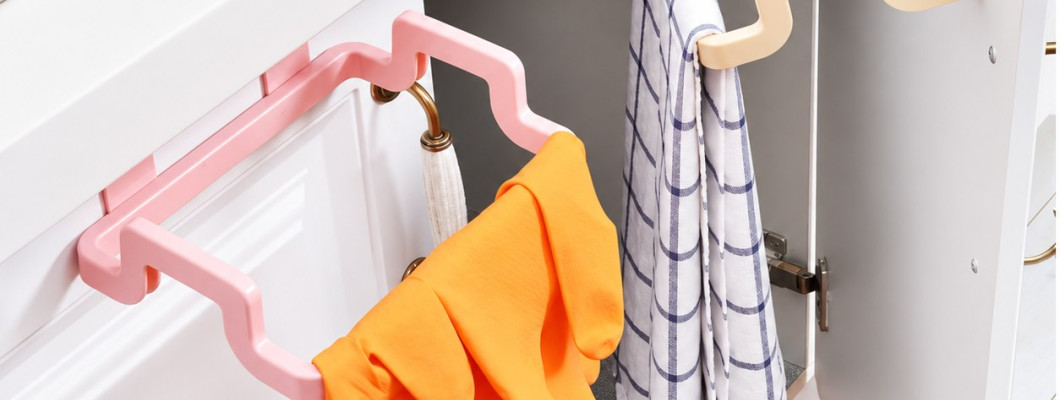
The MC50 bag and towel holder from K&M Shopping is a plastic frame with two integrated hooks that hang over a compatible cabinet-door edge. It requires no drilling or adhesive and is intended for a small bag or lightweight towels, cloths, and gloves.
The listed quantity is one holder. Exact dimensions, compatible door thickness, plastic type, and maximum load are not specified. Several colors appear in the images, but no separate color selector is shown.
Review the product here:
https://k-m.store/shop/en/mc50-multi-purpose-bag-towel-holder-kitchen-organizer-for-bags-and-towels
Use the listing to understand the intended function, then clarify any missing detail that determines whether it will suit your cabinet.
Check the Door Edge, Not Just Its Width
The overall width of a cabinet door tells you little about whether a particular hook will fit. Examine the exact edge where the accessory would rest.
Look at its thickness and profile. A decorative detail, lip, or change in shape may matter even when the main door surface appears flat.
Then examine the relationship between the door and its surrounding frame when closed. Hanging an accessory on an open door is only part of the compatibility question.
Record the measurements that relate to the attachment. A clear photograph can help explain the cabinet’s construction, but it should accompany useful measurements rather than substitute for them.
Turn Missing Information into Specific Questions
When important dimensions are absent, ask a question that explains your proposed installation. “What door-edge thickness can the hooks accommodate?” is more useful than “Will this work in my kitchen?”
If your cabinet has a particular feature, describe it. Ask which product measurements are needed to compare the two designs.
Do not estimate measurements from a towel or glove shown in a photograph. Those items vary, and perspective can make proportions misleading.
If the seller cannot confirm a detail essential to your decision, keep that uncertainty visible. Avoid turning an incomplete listing into an assumption that the product will fit because it is small or described as convenient.
Why No-Drill Does Not Mean Universal Fit
An installation method describes how an accessory attaches. It does not establish suitability for every cabinet profile, finish, or layout.
Likewise, an accessory that can be removed is not automatically guaranteed to leave every surface unaffected. Check the care guidance for your cabinetry and do not assume protective features that have not been stated.
Avoid modifying the installation with improvised materials unless appropriate instructions support doing so. A workaround can change the clearance or the way the accessory contacts the door.
The goal is a compatible arrangement that works normally, rather than one that appears usable only after pressure, bending, or changes to the cabinet.
Choose a Location Around the Task
Stand where you normally prepare food and consider the proposed location from that position. Would using it require an awkward turn, a step into someone else’s path, or frequent movement around an open door?
Then think about the cabinet itself. If you repeatedly need items from inside it during the same task, the arrangement may introduce an inconvenience.
Consider adjacent drawers and doors too. A location should work as part of the kitchen, not just as an isolated spot.
Finally, account for the hanging contents. The space occupied by a bag or towel can differ from the footprint of the empty frame. Review the whole arrangement rather than the accessory alone.
Carry Out an Empty Installation Check
Following the product instructions, place both hooks over a suitable edge and check that the frame sits evenly. Close the door slowly, without forcing it.
For bag use, the listing describes passing the opening through the frame and folding its edges around the sides. Check placement before adding contents.
If resistance or an unsuitable contact point appears, stop and reassess. Do not use the door’s closing force to overcome a fit problem.
Open the cabinet again and review ordinary access. A product may fit physically yet still be poorly located for the way you use that cupboard.
Plan the Bag Around One Session
Choose a suitable, intact bag for the task you have identified. Do not use whichever bag happens to be nearby without checking its condition and how it sits.
If it does not fit the arrangement comfortably, select another appropriate option rather than stretching it into place. A photograph cannot establish a standard bag capacity.
Define when the bag will be removed: after preparing the vegetables or finishing the packaging task, for example. This gives the temporary setup a clear endpoint.
Deal with unsuitable or excessive contents earlier when necessary. The endpoint is an organizational reminder, not a reason to ignore a problem until the whole task is complete.
Keep Waste Sorting Separate from Convenience
A nearby bag is useful only for contents appropriate to that setup. Do not let convenience override the way different household waste should be handled.
Separate materials according to the arrangements you follow at home. Sharp objects, broken glass, and other unsuitable contents need an appropriate method of disposal rather than a place in a temporary lightweight collection point.
Avoid combining everything simply because it is small. Material type and condition matter as well as size.
This approach keeps the organizer’s role limited and understandable. It supports a particular task instead of becoming an undefined destination for anything you want off the counter.
Give a Towel a Clear Purpose
If towel storage is your main need, decide which towel belongs there. A hand towel and a cloth used for a particular cleaning task should not become interchangeable merely because they share a convenient location.
Check the actual towel’s length and how it hangs. Consider whether it reaches the floor, catches nearby hardware, or interferes with normal cabinet use.
Follow the towel’s care instructions and the cabinet’s surface-care guidance. Providing a hanging point does not clean the fabric or automatically make every drying arrangement suitable.
A recognizable purpose helps other household members use the setup consistently. Often, a simple agreement is more useful than adding several more hooks.
Reset Before Changing Functions
If you switch from supporting a waste bag to holding a clean towel, treat that as a reset rather than a quick exchange.
Remove the contents, inspect the area, and clean and dry as needed before the next use. Include the cabinet surface if the previous task affected it.
If frequent switching becomes inconvenient, choose the function that offers the greatest everyday benefit. Multi-purpose products provide options; they do not require constant changes.
The simplest arrangement is often the one everyone understands. A holder that consistently performs one useful job may be more valuable than one that attempts several jobs awkwardly.
Example: Preparing One Vegetable-Based Meal
Gather the ingredients and utensils before starting. Identify where appropriate lightweight preparation waste will go, and check that the proposed setup does not interfere with your working position.
During the task, notice whether you need to open the same cabinet repeatedly. If so, decide whether preparing your tools earlier or choosing another suitable location would help.
At the end, remove the contents and restore the area. Assess the complete session, including cleanup.
This matters because a setup can feel convenient during preparation but create extra work afterward. Judge it by the whole task rather than one moment.
Example: Unpacking Kitchen Purchases
When putting away new purchases, separate what you need to keep from packaging that can be removed. Decide on the appropriate destinations before opening everything.
A temporary collection point may help with suitable lightweight materials, while other items belong in your normal sorting or disposal system.
Keep access to the cabinets you are filling in mind. An accessory placed on the door you need most could interrupt the task.
Finish by clearing the temporary arrangement. The goal is to complete unpacking, not leave a record of yesterday’s shopping hanging beside the counter.
Example: A Kitchen Used by Several People
A setup that is obvious to you may be interpreted differently by someone else. One person may see a towel location while another sees a place to hang miscellaneous items.
Agree on the purpose and the finishing routine. Whoever completes the task should know what to remove and how to leave the area ready.
If extra items keep appearing, ask what need they represent. Another person may be trying to solve a storage problem you have not considered.
Address that need directly rather than repeatedly clearing the holder without changing the reason it becomes crowded.
Common Mistakes to Avoid
Choosing appearance before compatibility
Color preferences matter after the product suits the location and task. Verify the available ordering options rather than assuming a photographed color can be selected.
Filling every visible space
An open frame is not an invitation to add more objects. Keep the arrangement connected to its intended purpose.
Forgetting access behind the door
Review the contents of the cabinet as well as the area outside it. The arrangement should not make a frequently used cupboard inconvenient.
Accepting resistance during closure
Normal operation matters. Reassess the fit instead of treating pressure as something the cabinet will adapt to.
Keeping an unhelpful setup out of habit
If the arrangement creates more work than it removes, change the location or reconsider the solution.
Cleaning and Checking Condition
The listing recommends wiping with a damp cloth or hand-cleaning with mild soap and water, then drying. Dishwasher and high-temperature suitability are not confirmed.
Inspect the holder when it is empty, and discontinue use if the hooks or frame are damaged. Follow the cabinet manufacturer’s guidance when caring for the contact area.
Connect this check to an existing routine, such as finishing preparation or cleaning the surrounding work area.
You do not need a complicated maintenance schedule. A consistent opportunity to inspect and reset the arrangement is more practical than waiting until something becomes difficult to clean.
Review the Setup Each Week
Ask three questions: Did the holder help with the original task? Does the cabinet still operate normally? Have unrelated items started accumulating?
If the arrangement works, keep it simple. There is no need to expand it just because other accessories are available.
If a problem appears, make one change and assess it. You might relocate the setup, reduce its contents, or choose a different use.
For other kitchen organization options, explore K&M Shopping:
https://k-m.store/
Browse with a defined task in mind. A clearer routine may solve the issue as effectively as another storage product.
Before-Use Checklist
I know whether the primary purpose is bag support or towel storage.
I have checked the relevant cabinet edge and clearance.
Important missing measurements have been clarified.
The empty installation does not require force.
The door and nearby drawers remain practical to use.
The hanging contents have enough appropriate space.
The task has a clear finishing and cleanup routine.
Other household members understand the arrangement.
I will reassess it if the location or use changes.
Quick Answers
Best starting point: Identify a repeated interruption during an ordinary kitchen task.
Most important comparison: The actual cabinet construction against the attachment requirements.
What photographs show: The intended arrangement, not confirmed dimensions or load capacity.
What makes a good location: It supports the task without complicating access or movement.
How to judge success: Evaluate preparation, use, and cleanup together.
Frequently Asked Questions
Will an over-cabinet holder fit every kitchen?
No universal fit should be assumed. Door profiles and clearances vary. Compare the relevant details and resolve missing information before relying on a particular installation.
Can I choose a position by looking only at the empty frame?
No. Consider the bag or towel, normal cabinet access, and nearby movement. The contents may occupy considerably different space from the frame alone.
What if I cannot find the dimensions I need?
Ask the retailer for the specific measurements that determine compatibility. Explain the cabinet feature you are checking. If the information remains unavailable, do not replace it with a guess.
Is a larger bag automatically a better choice?
No. Choose a bag appropriate to the holder and task. Extra capacity can encourage keeping more contents than intended and does not establish that the arrangement can support them.
Do I need to use both functions?
No. You can select one primary use. The ability to change functions is an option, not a requirement, and a consistent arrangement may be easier for the household to maintain.
Should a temporary bag stay in place after preparation?
Give the task a clear endpoint and deal with its contents appropriately. Avoid allowing a short-term arrangement to become unreviewed storage simply because the immediate cooking task has finished.
How do I choose which towel belongs there?
Decide its purpose and check its dimensions in the proposed location. Follow its care instructions, and make the intended use clear to anyone sharing the kitchen.
What should I do if the cabinet becomes awkward to use?
Reassess the arrangement. Physical installation alone is not enough if normal access or movement becomes inconvenient. Another compatible location or a different solution may be more suitable.
How can I stop unrelated objects accumulating?
Assign the holder a clear purpose and review the contents when finishing the task. If new objects repeatedly appear, identify the separate storage need behind them rather than simply moving them elsewhere.
How do I know whether the purchase was useful?
Return to your original problem. Has the task become easier from setup through cleanup without creating interference? Evaluate that result instead of relying solely on the appearance of the organized area.
Step-by-Step Starting Plan
Step 1: Observe one familiar kitchen task.
Step 2: Identify the specific interruption you want to reduce.
Step 3: Review existing counter and cabinet organization.
Step 4: Check the proposed door edge, clearance, and access.
Step 5: Clarify relevant product information before buying.
Step 6: Test the empty installation gently.
Step 7: Introduce suitable contents for one defined purpose.
Step 8: Complete the task, clean up, and assess the result.
Conclusion
A useful kitchen organizer fits both the cabinet and the routine around it. Start with a specific task, check the installation requirements, and make the end-of-task reset part of the plan.
The best arrangement is one you can understand, use, and maintain without repeatedly working around it.
Quick Summary
Define the job before choosing the location.
Check the door edge and closing clearance.
Ask about missing compatibility information.
Test without force.
Keep temporary use distinct from everyday storage.
Reset when changing functions.
Review the whole task, including cleanup.
Read Also
For another part of organizing meal preparation, read the guide to storing parsley, cilantro, and mint in the refrigerator:
https://k-m.store/shop/en/store-parsley-cilantro-mint-fridge-guide
Leave a Comment