
How to Store Parsley, Cilantro and Mint in the Fridge: A Practical Herb Keeper Guide
How to Store Parsley, Cilantro and Mint in the Fridge: A Practical Herb Keeper Guide
You buy fresh herbs for a recipe, use a handful, and return the rest to the refrigerator. A few meals later, you cannot remember which bag contains the parsley or whether the cilantro belongs to this week’s shopping.
Keeping herbs useful involves more than choosing a container. You need a suitable storage method, a clear place for each purchase, and a realistic idea of when you will use it. Otherwise, even neatly stored ingredients can be overlooked.
This guide explains how to build a manageable routine for parsley, cilantro, and mint, where a herb keeper fits into that routine, and what to check before buying one. It also covers the important distinction between keeping ingredients organized and knowing whether they are suitable to eat.
Quick Answer
For herbs suited to refrigerated stem-in-water storage, prepare them carefully, keep the stem ends in clean water, and leave the leaves above the waterline. Monitor the herbs and maintain the container. Storage needs vary by herb and packaging, so follow relevant instructions rather than assuming one method or a fixed freshness period works for everything.
Contents
Identify the problem you want to solve.
Choose herbs around meals you will make.
Understand the differences between herb types.
Prepare a clean workspace.
Check whether a herb keeper suits your refrigerator.
Set up and maintain your storage routine.
Plan practical uses for the remaining herbs.
Avoid common mistakes.
Review your shopping habits.
Use the checklist, quick answers, and FAQs.
Start with the Problem, Not the Container
Before changing your storage setup, consider what usually happens to your herbs. Do you forget they are there? Buy another bunch unnecessarily? Struggle to identify different varieties? Or purchase more than your recipes require?
These problems overlap, but they are not identical. A visible storage location can make checking easier. A shopping-list habit can prevent duplicate purchases. Smaller quantities may better match occasional use.
Describe the most frequent difficulty in one sentence. For example: “I buy cilantro for one dinner and never decide what to do with the rest.”
That observation gives you a useful starting point. Improving storage may help you manage the ingredient, while planning another suitable meal addresses why it remains unused.
Buy for Real Meals
Look at the recipes you genuinely expect to prepare before buying several bunches. A dish you cook regularly is a stronger plan than an unfamiliar recipe you might try if time allows.
Estimate how the herbs fit into those meals. Some recipes use a substantial amount; others call for a small garnish. Buying the same quantity for both situations can leave very different amounts behind.
When possible, choose a purchase size that suits your needs. If only larger bunches are available, decide how you will handle the remainder before buying.
Keep that decision realistic. You do not need to redesign the week’s menu around one ingredient. If using the remainder would require numerous extra purchases, buying less or choosing another suitable option may be simpler.
Identify the Herb Before Choosing Its Storage Method
Parsley, cilantro, mint, basil, and woody herbs should not automatically receive identical treatment. Their condition and preparation also matter: a whole bunch is different from a package of chopped leaves.
Check the label on prepared or packaged herbs. Storage directions and use-by information belong with that particular product, even if you normally handle loose bunches differently.
Fresh basil deserves special attention. University of Maine Cooperative Extension advises that basil does not store well in the refrigerator and recommends keeping its stems in water at room temperature. Do not extend that advice to every packaged or prepared basil product; follow its label.
The practical lesson is to identify what you have first. Choose the storage method next, then select a container that supports it.
Prepare a Clean Workspace
Handle herbs on a clean surface with clean hands and utensils. Keep produce separate from raw meat, poultry, seafood, and equipment contaminated by them.
FDA guidance recommends washing produce under running water before preparation or eating. Do not use soap or household detergent on herbs. Washing reduces contamination but does not make spoiled food suitable to eat.
If you wash herbs before storage, gently remove excess surface water with a clean cloth or paper towel. Follow the label for produce sold as prewashed or ready to eat.
Keep food preparation and container cleaning distinct. A mild detergent may be appropriate for washing the empty keeper according to its care instructions, but it is not a treatment for the leaves.
Decide Whether Upright Storage Fits Your Routine
Think about how you buy and use herbs. Do you usually bring home whole bunches with stems, or mostly small packets prepared for a single recipe?
An upright keeper may be relevant when your chosen storage method involves keeping stems in water. It may be less useful if most of your purchases require a different arrangement.
Also consider the maintenance you are willing to perform. A container is part of a routine, not a replacement for one. Choose a method you can check and maintain during ordinary kitchen use.
Try to connect the check with something you already do, such as gathering ingredients for lunch. An existing habit is easier to remember than a separate task with no regular place in your day.
Check the Product Details
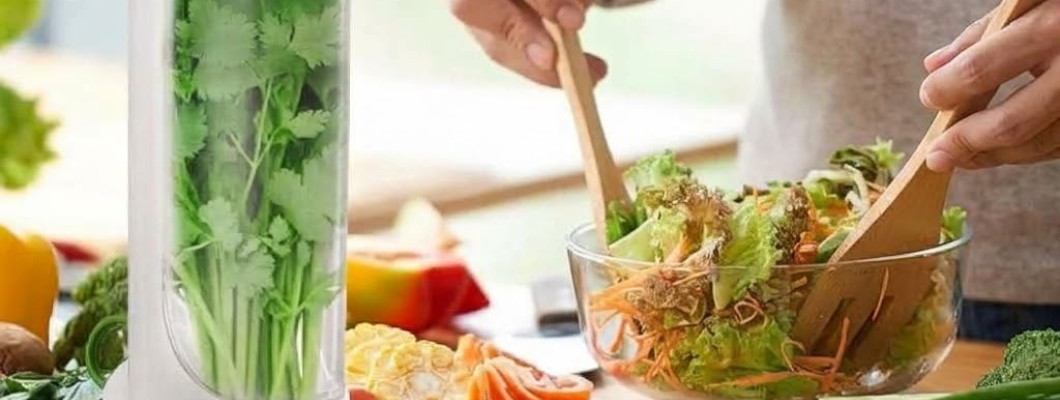
The Fresh Herb Keeper & Vegetable Storage Container from K&M Shopping has a lower water reservoir, a transparent viewing section, and front access.
The listing specifies ABS construction, an approximate height of 24.5 cm, and an approximate base measurement of 6.5 cm. It is washable, reusable, and requires no electricity or batteries.
You can review the product here:
https://k-m.store/shop/en/fresh-herb-keeper-container
A capacity in liters, a guaranteed bunch count, and dishwasher or microwave compatibility are not stated. Do not infer those details from the photograph. The listed dimensions describe the product’s size, not how much of every herb it will accommodate.
Measure Access as Well as Shelf Height
Before ordering a tall container, measure the space where you expect to place it. Consider existing shelf arrangements and the containers already stored nearby.
Then think about removal. A keeper may fit when stationary but still be awkward to take out if several other items block it. Repeatedly rearranging a shelf can make a simple ingredient check inconvenient.
Imagine the complete movement: opening the refrigerator, reaching the container, placing it on a work surface, and returning it afterward.
Follow your refrigerator’s guidance when adjusting shelves or arranging food. Create a suitable location without compromising access, separation of foods, or normal use of the appliance.
Set Up the Keeper
Following the product’s instructions, add clean water so it reaches the stem ends without covering the leaves. Arrange the herbs without crowding, close the cover, and keep the container upright in the refrigerator.
If the bunch does not fit comfortably, divide the quantity or choose another suitable storage arrangement. Do not force the cover closed around an oversized bundle.
For herbs stored with their stems in water, Iowa State University Extension recommends changing the water daily. Include that task in your routine instead of waiting for the contents to be forgotten.
Maintain the container as directed: wash the reservoir and cover with mild detergent and water, rinse, and dry between uses. Avoid abrasive cleaning tools and high heat.
Give Each Purchase an Identity
A simple note can help distinguish one purchase from another. Record the herb name and the date you placed it into storage, especially if more than one person shops.
The date is a memory aid, not a calculated expiry date. It cannot establish safety or replace the package instructions and appropriate food handling.
Keep separate purchases identifiable while checking them. Automatically mixing a new bunch with an older one makes it harder to know what you have and how it has been handled.
You do not need a detailed inventory. A short note such as “parsley for tomorrow’s salad” is enough to connect the ingredient with a planned use.
Plan the Second Use
When a recipe leaves herbs behind, choose a second familiar dish that already fits your menu. This gives the remaining ingredient a purpose without creating an entirely new cooking project.
For parsley, that might be another salad or a dish you already prepare. Cilantro could fit a second meal in your usual rotation. Mint may have a place in a planned drink or another recipe you enjoy.
Keep preferences in mind. An ingredient is unlikely to be used just because a recipe technically accepts it.
Plan while the herbs are suitable for use. Meal planning is not a reason to overlook spoilage or stretch a storage instruction. If longer-term preservation is needed, use guidance specific to the herb and method.
Example: Cooking Regularly with Parsley
Suppose parsley appears in several meals your household already enjoys. Start by checking what remains before adding it to the shopping list.
After storing the new purchase appropriately, note the next meal that will use it. During preparation, remove what you need with clean hands or utensils and return the remaining herbs to their suitable storage location.
At the next shopping review, look at the outcome. Did the quantity match your meals? Did a canceled dinner leave more than expected? Did someone use the parsley for another dish?
Use that information to adjust the next purchase. You are learning your household’s consumption pattern rather than trying to make every bunch last a predetermined number of days.
Example: Buying Mint for Guests
Mint bought for visitors may be used differently from an everyday cooking ingredient. The number of guests, the drinks served, and individual preferences can change the amount required.
After the occasion, review what remains and whether there is a realistic near-term use. Do not assume another gathering will happen before you need to make a decision about the herbs.
For the next event, use your experience to guide the quantity. A brief note about what was actually used is more useful than repeating the same purchase automatically.
The goal is to match buying with your routine, while maintaining appropriate storage throughout.
Make a Shared Kitchen Easier to Manage
When several people use the refrigerator, agree on where herbs belong and how new purchases are handled. Otherwise, one person may buy replacements while another is already storing the same ingredient.
Keep the arrangement understandable. Everyone should be able to identify the herbs and see whether they are reserved for an upcoming recipe.
If plans change, update the information. A bunch marked for a canceled meal should not remain mentally unavailable to everyone else.
Also agree on who resets an empty container. Cleaning it promptly leaves the next person a usable item instead of an unfinished task. The simpler this routine is, the more likely it is to continue.
Common Mistakes to Avoid
Buying more because storage looks organized
A tidy refrigerator does not create extra meals. Keep quantities linked to actual use rather than available container space.
Treating every herb the same
Check the variety and packaging before applying a familiar method. A routine that suits one purchase may not suit another.
Using the date as the only decision
A storage note supports memory. It does not override food condition, handling history, or label instructions.
Keeping an inconvenient layout
If you repeatedly move several containers to reach the herbs, reconsider the location. Easy access supports consistent checking.
Assuming missing specifications
Do not guess appliance compatibility, internal capacity, or special performance claims. Ask for clarification when a missing detail affects your decision.
Review Before the Next Shopping Trip
Open the refrigerator before writing your list. Identify what is present, what is suitable for use, and which planned meals already have their herbs accounted for.
If unused quantities recur, change one part of the process. You might buy less, shop at a different interval, or make the meal note more visible.
Avoid changing everything simultaneously. A small adjustment is easier to assess, and you can keep it if it helps.
For storage accessories and other kitchen items, explore K&M Shopping:
https://k-m.store/
Browse with a defined task in mind. Sometimes the useful purchase is a suitable keeper; sometimes the improvement is simply a clearer shopping list and a more accessible shelf.
A Checklist for Your Next Bunch
Identify the herb and check any package instructions.
Review existing herbs before adding a new purchase.
Prepare a clean workspace and suitable utensils.
Inspect the bunch and discard spoiled produce.
Choose a storage method appropriate to the herb.
Check that the container fits without overcrowding.
Keep a simple note if it helps distinguish purchases.
Plan a realistic meal that uses the ingredient.
Include maintenance in your usual kitchen routine.
Quick Answers
Where to start: Identify the herb and the problem in your current routine.
What to measure: The available space and the access needed to remove the container.
What a date note does: Helps you remember when a purchase entered storage.
What it does not do: Guarantee freshness or establish safety.
When to change your buying habits: When suitable storage still leaves more herbs than your meals require.
Frequently Asked Questions
Are cilantro and coriander leaves different ingredients?
In American English, cilantro usually refers to the fresh leaves and stems, while coriander commonly refers to the seeds. In other English-speaking regions, the leaves are often called coriander. Check which form your recipe requires before buying.
Can I use one storage method for every fresh herb?
No. Identify the herb and check relevant storage guidance. Also follow instructions on prepared or packaged products. The method you use for a loose bunch should not automatically replace directions supplied with a different form of the ingredient.
Should I wash herbs with soap?
No. Use running water as recommended for fresh produce, not soap or household detergent. Keep the distinction clear between washing food and cleaning an empty container. Follow the label when herbs are supplied prewashed or ready to eat.
How long will herbs remain fresh?
There is no universal period that applies to every bunch or container. Initial condition, herb type, handling, and storage conditions vary. Avoid treating an estimated duration as a guarantee, and follow applicable package instructions.
Does a clear container prove the contents are safe?
No. Visibility helps you locate and inspect food, but appearance alone does not establish safety. Consider proper handling and storage as well. Do not taste questionable herbs to test them, and discard produce showing spoilage.
Can I add a new purchase to an older bunch?
Check and identify the existing herbs first. Keeping purchases distinguishable makes tracking easier. Combining everything immediately can obscure what was bought when and make it harder to manage different conditions or planned uses.
Should I chop the entire bunch immediately?
Only if that preparation suits your intended use and storage method. Whole bunches and chopped herbs are not interchangeable storage situations. Follow suitable guidance for the form you choose rather than chopping simply to make everything fit.
Do I need more than one keeper?
That depends on your routine, available space, and the quantities you actually use. Start with the storage task you need to solve. Buying extra containers is unlikely to address repeated overbuying or a lack of meal planning.
What should I do if my meal plans change?
Review the herbs and identify another realistic use while they remain suitable. Update shared notes if someone else cooks. If longer-term preservation is needed, consult guidance for that particular herb rather than improvising a method.
What is the simplest habit to maintain?
Check your herbs while collecting ingredients for a meal, then review them again before shopping. These existing activities provide natural reminders. A short, repeatable check is generally easier to maintain than a complicated inventory system.
Step-by-Step: Start with One Herb
Step 1: Choose a herb you regularly use
Begin with an ingredient already connected to familiar meals.
Step 2: Review your current difficulty
Identify whether the issue is visibility, access, quantity, or an unsuitable storage routine.
Step 3: Check the appropriate method
Follow herb-specific guidance and package instructions.
Step 4: Prepare the space and container
Make sure both cleanliness and access are practical.
Step 5: Store and identify the purchase
Use a simple note if it helps, without treating it as a freshness guarantee.
Step 6: Connect the remaining quantity to a meal
Choose something realistic within your normal cooking routine.
Step 7: Maintain and reassess
Complete the required care and adjust the next purchase based on actual use.
Conclusion
A useful herb storage routine connects shopping, preparation, maintenance, and cooking. A suitable keeper can provide a designated place, while your everyday habits determine whether the ingredients remain visible and get used appropriately.
Start with one herb, one practical location, and one realistic meal plan. Build from what works in your kitchen.
Quick Summary
Buy around meals you expect to prepare.
Match the method to the herb.
Follow produce hygiene and package instructions.
Check space and access before choosing a container.
Maintain the storage setup consistently.
Use dates as reminders, not guarantees.
Review existing herbs before shopping again.
Read Also
Organizing other ingredients for planned meals? Explore the guide to vacuum food storage bags and freezer portions. This is a separate storage method whose suitability depends on the food and its handling requirements:
https://k-m.store/shop/en/blog/vacuum-food-storage-bags-portion-freezer-guide
Leave a Comment