
How to Dry Clothes While Travelling: A Portable Clothesline Setup Guide
How to Dry Clothes While Travelling: A Portable Clothesline Setup Guide
Washing a few items during a trip can seem straightforward until you need somewhere to dry them. The room has limited space, the bathroom is already in use, and tomorrow’s departure leaves little room for an improvised laundry arrangement. At home, a similar problem appears when you have a few lightweight items but do not want to set up a large drying rack.
A portable clothesline can provide temporary hanging space where suitable attachment points are available. It does not, however, make every room or outdoor location suitable for laundry. The position, supports, garment care requirements and time available all matter.
This guide explains how to assess a temporary drying setup, arrange movable clips and plan small laundry batches. It also covers the confirmed details of K&M Shopping’s flexible clothesline without assuming a load rating, material or guaranteed drying time that the product listing does not provide.
Quick Answer
Choose the drying location before washing your clothes. Confirm that both attachment points are appropriate and stable, that the line will not obstruct movement, and that the garments can be hung according to their care instructions. Secure the line, arrange lightweight items with space between them and monitor the setup. Clip count does not establish load capacity, and a portable line cannot guarantee that clothes will dry before checkout.
Contents
Decide whether a temporary clothesline suits the task.
Review the K&M line’s confirmed specifications.
Choose the location and attachment points.
Understand length, tension and load limits.
Prepare garments and arrange the clips.
Plan laundry around your travel schedule.
Adapt the setup to home and outdoor use.
Check progress, clean and store the line.
Review common mistakes and frequently asked questions.
Follow a step-by-step starting plan.
Decide What You Need to Dry
Begin with the actual items rather than the space you hope to fill. A few socks, underwear and lightweight garments present a different task from a large wash containing heavy fabric and bulky towels.
A temporary line may be useful for a small batch when suitable supports exist. If the task involves heavy wet items or garments that require flat drying, another arrangement may be more appropriate. Owning a clothesline does not mean every washed item should go on it.
Also consider whether you need to wash the items at all during the stay. A smaller, necessary batch is easier to plan around than washing everything because there appears to be room for several clips. Match the laundry plan to the facilities and remaining schedule.
What the K&M Flexible Clothesline Includes
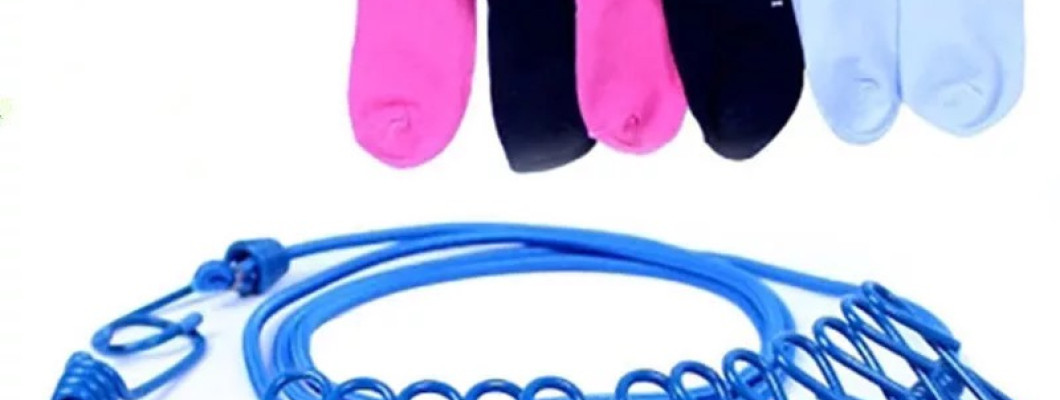
K&M Shopping lists a portable flexible clothesline extending up to 3 metres, fitted with 12 movable clothespins. The clips can be repositioned to adjust spacing for different garments and the available setup.
You can review the product here:
https://k-m.store/en/flexible-clothesline-with-clips
The stated package content is one clothesline with 12 clips. The listing describes use at home, while travelling and during camping trips, in appropriate indoor and outdoor locations. Colour is selected from the options available on the product page.
The exact material and maximum load capacity are not specified. Machine-washing instructions and claims of rust resistance or permanent weather exposure are also not established. Keep those limits in mind instead of treating the number of clips or the stated length as proof of heavy-load capability.
Choose the Drying Space Before Washing
Identify the potential position while the clothes are still dry. Look at the distance between supports, what is underneath, whether garments would touch surrounding surfaces and how people normally move through the area.
Avoid creating a barrier across a doorway or an everyday walking route. Make sure doors and windows that need to open can still operate. Do not position dripping clothes above electrical equipment or surfaces that could be damaged by water.
Consider ventilation as part of the location choice. A crowded corner with overlapping clothes is not equivalent to a more open arrangement. Drying depends on the fabric, remaining moisture and surrounding conditions, so choose a workable environment before committing to the batch.
If no suitable space exists, use another available solution, such as an appropriate drying rack or a laundry service. It is better to change the plan early than to improvise questionable supports with a collection of wet clothes waiting.
Assess the Attachment Points Properly
Two reachable objects are not automatically suitable supports. The points need to be appropriate for the forces applied by the line and laundry. A handle, decorative fitting or piece of furniture should not be assumed suitable simply because it feels firm when touched.
Examine the actual ends of the line and follow its supplied instructions. Confirm how those ends connect to the intended supports. Do not invent a fastening method based on unrelated accessories or try to compensate for an unsuitable connection by stretching the line harder.
In accommodation or shared spaces, use permitted locations without damaging fixtures or inconveniencing others. Keep the line away from young children and play routes. A temporary setup should remain compatible with the room’s ordinary use throughout the time it is installed.
What “Up to 3 Metres” Means for Planning
The listed length describes the product’s stated reach. It does not mean you should stretch the line to its maximum distance for every use. Choose a suitable span and follow the product instructions, avoiding excessive stretching.
Length and load capacity are separate specifications. A line that reaches across a space does not automatically support the quantity of wet clothing you want to put there. The listing does not provide a maximum load figure, so do not derive one from length or appearance.
If the available span does not allow an appropriate setup, change locations or use another drying method. Adding improvised extensions or applying extra force is not a substitute for choosing a space that suits the product.
Prepare Each Garment According to Its Care Label
Read the garment’s drying instructions before deciding where it belongs. Some items should not be hung, and some fabrics should not be wrung forcefully. A convenient line does not override the clothing manufacturer’s care guidance.
Remove excess water only in a way appropriate to the item. Remember that a wet garment can place more load on the setup than it did when dry. Do not judge a batch solely by how light the clothes felt before washing.
Open and arrange suitable garments before hanging them rather than leaving them folded into dense bundles. Choose an appropriate gripping position for the clips and fabric. If an item requires flat drying, provide that arrangement separately instead of forcing it into the hanging plan.
Twelve Clips Do Not Necessarily Mean Twelve Garments
Clips provide gripping positions, not a guaranteed item count. One garment may need more than one clip, while its width can occupy more of the line than several small items.
Start with the space each piece needs, then distribute the clips around that requirement. Do not make using every clip the goal. Leaving some unused can be more practical than placing garments so close together that they remain in contact.
Adding extra clips to a heavy item does not create a new load rating for the line or its supports. Clips may help with positioning, but they do not confirm that the overall setup is suitable for the item’s weight.
Arrange Small Items Without Bunching Them
Socks and other small pieces can be grouped within a section of the line while retaining separation. Use the movable clips to adjust the arrangement rather than pushing everything together at one end.
In a shared travel setup, keeping each person’s items recognisable can make collection easier. However, do not prioritise ownership groups over adequate spacing. A clear arrangement still needs room for the individual pieces.
Check the spacing after hanging. Fabric may move or settle differently once placed on the line. The ability to reposition clips is useful, but it does not guarantee that every garment remains in exactly the same position under all conditions.
Give Wider Garments Their Own Space
Wider items need enough room to be arranged according to their care requirements without crowding neighbouring pieces. Avoid gathering an entire garment into one compact section simply to save clips.
The listing mentions towels, but that should not be read as confirmation for every towel size and wet weight. A lightweight piece and a large water-heavy bath towel are different loads. If suitability is uncertain, choose an appropriate alternative rather than testing the line with a heavy item.
Distribute suitable items along the usable space rather than concentrating everything in the middle or at one end. Observe the setup as each piece is added. This check does not replace a stated load rating, but it can reveal movement that requires stopping and removing the laundry.
Plan Travel Laundry Around Departure
Work backwards from when you need the clothes and when you leave. Washing a large batch late in the evening before an early departure creates a timing problem if you have not assessed the drying conditions.
There is no fixed drying time that this line can promise. Fabric, remaining water, ventilation, weather and spacing all affect the result. Plan an alternative for items that may not be ready rather than relying on a universal overnight-drying expectation.
For a short stay, smaller necessary batches may be easier to manage. Leave time not only for the clothes, but also for checking them, taking down the line and drying the product before packing.
Before returning items to clean clothing groups, check the actual garment, including thicker areas and overlapping sections. Do not assume that one dry-feeling surface represents the whole piece. Pack what is ready and make an appropriate separate plan for anything still damp.
Three Practical Use Scenarios
A Small Apartment with a Few Items
Choose a suitable temporary space that does not interfere with the room’s normal use. If the batch is small and appropriate for the line, arrange it without crowding and remove the setup once it is no longer needed.
A Stay Lasting Several Days
Inspect possible attachment points before washing. Begin with a manageable batch and prioritise the pieces you will need first. Allow for differences between fabrics and changes in your plans rather than assuming every item follows the same schedule.
A Camping Trip
Use suitable stable supports and keep the line outside walking and play routes. Monitor the weather and the position of the laundry. Outdoor suitability does not establish unrestricted resistance to wind or rain, or justify leaving the setup unchecked.
Check Progress Without Rearranging Everything
After hanging the batch, see whether gaps remain and whether any garment has come into contact with a nearby wall or surface. One targeted adjustment may be enough; there is no need to move the entire load automatically.
Collect items that are ready when practical and use the freed space to improve the arrangement of the remaining pieces. Do not immediately add more washing just because clips become available. Reconsider the location, load and remaining time first.
If an attachment point moves or the setup develops unexpected slack, stop using it and remove the laundry safely before investigating. Do not keep adding items or respond simply by pulling the line tighter. Resolve the underlying issue or use another method.
Common Mistakes to Avoid
Using Clip Count as a Weight Limit
Twelve clips do not mean twelve items of any size or weight. Consider the garments, their wet condition, their spacing and the absence of a stated maximum load.
Washing Before Finding a Suitable Location
Wet clothes waiting for a home can encourage poor attachment choices. Identify the drying arrangement first, then decide how much laundry it makes sense to wash.
Stretching to the Maximum Without a Reason
The available length is not a target. Use an appropriate span and follow the instructions rather than forcing the product to accommodate an inconvenient location.
Crowding Clothes to Save Space
If items overlap heavily, reduce the batch or use additional suitable drying space. Moving clips closer together does not necessarily make the overall arrangement more effective.
Assuming Outdoor Use Means Weatherproof
Check changing conditions and the stability of the setup. Do not infer rust resistance, storm resistance or suitability for permanent outdoor storage from a general outdoor-use description.
Clean and Dry the Line Before Packing
After collecting the laundry, remove dirt with a damp cloth when needed, as described in the product listing. Let both the line and clips dry fully before storage. Avoid placing the damp product directly among clean clothes or inside a closed bag.
Handle the line without excessive pulling when taking it down and putting it away. Check the ends and clips for damage or changes in operation. Do not ignore a faulty part simply because other clips remain available.
Machine-washing instructions are not provided, so use the recommended gentle manual cleaning approach. Store the product dry and away from heat sources and open flames, arranged so it can be unpacked without tangling or sudden pulling.
Review It Before the Next Trip
Take the line out before packing for another journey. Count the clips, check their movement and inspect both ends. Confirm that the product is clean, dry and suitable to use, then decide whether the upcoming trip actually calls for it.
A successful setup in one place does not confirm suitability elsewhere. Different accommodation, support points or outdoor conditions require a fresh assessment. Treat the previous experience as useful background, not a guarantee.
Before-Hanging Checklist
A temporary drying space is genuinely needed.
Both attachment points are suitable and stable.
The line does not obstruct doors or walking routes.
The area is clear of electrical equipment and heat sources.
The span does not require excessive stretching.
Garment care instructions permit hanging.
Heavy or uncertain loads have another suitable solution.
Clothes are distributed rather than concentrated together.
Clips are positioned for the individual items.
Gaps remain between garments.
Outdoor conditions and stability can be monitored.
There is time to collect laundry and dry the line before packing.
Quick Answers
How long is the line? The listing states up to 3 metres.
How many clips are provided? Twelve movable clothespins.
Does that mean twelve garments? Not necessarily; some pieces need multiple clips and more space.
What is the maximum load? It is not specified.
How long will drying take? That depends on the garments and surrounding conditions.
When should the line be packed? After cleaning as needed and allowing the line and clips to dry fully.
Frequently Asked Questions
1. What is a flexible clothesline with clips useful for?
It combines a portable line and attached clips for temporary hanging space. Its usefulness depends on suitable supports, appropriate garments and enough room to distribute them.
2. What is the length of this K&M clothesline?
The product listing states that it extends up to 3 metres. This does not require using the maximum span or justify excessive stretching.
3. How many clips does it include?
It comes fitted with 12 movable clothespins. The number of garments you can appropriately arrange depends on their size, gripping needs and the overall setup.
4. Can the spacing between clips be changed?
Yes. The clips can be repositioned to suit different items. Arrange garments with space between them instead of concentrating everything in one section.
5. Is it suitable for travel?
Travel is one of the listed uses. Check the accommodation’s available space and suitable attachment points before relying on it as your drying solution.
6. Can it be used outside?
The listing allows for suitable outdoor locations. Secure the ends appropriately and monitor conditions; do not assume unrestricted weather resistance.
7. What is its maximum weight capacity?
A maximum load is not provided. Do not estimate one from the clip count or length, and avoid heavy loads.
8. Can it hold every type of towel?
The listing mentions towels but does not confirm every size or wet weight. Large, water-heavy towels require a different assessment from lightweight items.
9. Can I machine-wash the clothesline?
Machine-washing instructions are not stated. Clean gently by hand with a damp cloth when needed, then let the line and clips dry fully.
10. Will my clothes be dry before checkout?
The line cannot guarantee that. Plan around the fabric, remaining moisture and drying environment, with another option for items that are not ready.
A Step-by-Step Starting Plan
Identify the lightweight items that need washing.
Find a suitable location and attachment points first.
Check the span and actual end connections.
Prepare garments according to their care instructions.
Position clips around the space each item needs.
Hang without crowding and monitor stability.
Collect ready items and reassess the remainder.
Clean, dry and store the line after use.
Conclusion
A flexible clothesline can be useful when its location, supports and laundry are appropriate. Combining the line with movable clips makes a temporary arrangement easier to organise, but it does not establish an unlimited load or a guaranteed drying schedule.
Choose the space before washing, keep garments separated and leave time to check everything before packing. That approach makes temporary laundry drying a planned part of the stay rather than a last-minute problem.
Quick Summary
The K&M line extends up to 3 metres and includes 12 movable clips, while its maximum load is unspecified. Use suitable supports, choose appropriate lightweight items and do not equate clip count with garment capacity. Dry the line and clips before storage.
Read Also
Once clothing is dry, a clear packing system can make it easier to find and return items during the trip. Explore the guide to organising packing cubes by outfit or clothing type:
https://k-m.store/en/packing-cubes-by-outfit-or-clothing-type
You can also browse the home and travel products available at K&M Shopping:
Leave a Comment