
How to Pack Shoes in a Suitcase: Choosing a Travel Shoe Bag and Keeping Clothes Separate
How to Pack Shoes in a Suitcase: Choosing a Travel Shoe Bag and Keeping Clothes Separate
Clothes are folded, toiletries are packed and the suitcase is nearly ready. Then you reach the awkward part: finding somewhere for the shoes. A pair placed in the remaining gap may press against clothing, distort under the lid or become difficult to reach when you arrive.
A travel shoe bag gives footwear a separate place inside your luggage. However, the bag needs to fit the actual shoes, and those shoes should be prepared before packing. A tidy-looking arrangement does not automatically mean everything fits properly or is ready for storage.
This guide explains how to choose a suitable shoe bag, interpret its dimensions and plan footwear placement for both directions of a trip. It also covers the confirmed features of the K&M Shopping bag and the limits you should not overlook.
Quick Answer: How Do You Keep Shoes Separate from Clothes in a Suitcase?
Remove visible dirt using the care method appropriate to your footwear, make sure the shoes are dry and place them in a bag that closes without forcing or changing their shape.
Position the bag where it will not crush delicate belongings or be compressed by the rest of the luggage. Keep it separate when unpacking too: avoid opening used shoes directly over clean clothes.
A shoe bag helps organise and separate contents. It does not clean footwear, reduce its weight or automatically provide waterproof or odour-proof storage.
Contents
Choose the shoes your trip actually requires.
Understand separation, cleaning and compression.
Assess shoe-bag dimensions and capacity.
Review the K&M Shopping bag.
Prepare footwear and test the fit.
Choose a position inside the suitcase.
Plan shared luggage and special footwear.
Repack after use and for the return trip.
Check care and home storage.
Read ten frequently asked questions.
Choose Footwear Before Choosing Organisers
Start with the activities you expect to do. Walking, a particular event and ordinary daily use may call for different footwear, but every additional pair should have a clear purpose.
Consider whether one pair can cover more than one activity when that suits your needs. There is no universal number of shoes for every trip. The useful question is whether each pair supports the actual plan.
Next, decide what you will wear while travelling and what will go inside the suitcase. This establishes the packing problem before you buy organisers or assign space. Buying bags first and filling them afterwards can encourage unnecessary additions.
Separate Three Different Jobs
Cleaning, separating and compressing are different tasks. Cleaning removes dirt according to the footwear’s care requirements. A bag separates shoes from neighbouring belongings. Compression reduces volume and requires a product designed for that function.
A standard shoe bag can make a pair easier to identify and handle, but it does not make the sole smaller or guarantee extra suitcase capacity.
Likewise, putting dirty shoes inside a clean bag does not clean them. The contents and the bag may both need attention before the next use.
Choose the organiser for the job it actually performs. Treat it as part of a packing routine, not a replacement for preparing the footwear.
Measure the Shoes, Not Just the Labelled Size
Shoe size alone does not describe the space footwear occupies. Two pairs with the same labelled size can differ in sole thickness, upper height and overall bulk.
Check the actual length, width and height of the shoes you intend to pack. Consider the arrangement you want inside the bag rather than measuring one shoe and assuming the second will fit alongside it.
Rigid soles and structured uppers cannot simply be compressed to suit an undersized pouch. Delicate footwear may also require a different protective arrangement.
If the bag’s published measurements leave uncertainty, ask for clarification before relying on it for a particular pair.
Interpret Bag Dimensions Carefully
The K&M Shopping shoe bag has a listed size of 31 × 43 cm. This does not describe a rigid internal box with a guaranteed depth.
As shoes fill a flexible bag, their volume uses part of the fabric’s available span. Space is also needed to gather the opening. That is why a dimensional comparison is a starting point rather than a universal fit guarantee.
Do not assume that a shoe shorter than one listed measurement must fit comfortably. Width, height and closure space still matter.
If you need a precise answer for unusually bulky footwear, provide the seller with the actual shoe dimensions and ask what the stated bag measurement represents.
Decide Whether You Want to Store a Pair Together
Keeping both shoes together can make them easier to find, but it requires enough space for the pair without unsuitable pressure.
The product listing does not give a guaranteed capacity in pairs. Do not assume that every pair will fit or that visible spare space means a second pair can be added.
Consider how easily the shoes can be inserted, closed away and removed. A bag that only closes after forceful rearrangement is not a practical match.
If the desired arrangement does not fit, choose a different size or an appropriate number of bags. The aim is repeatable separation, not achieving closure once at any cost.
What the K&M Shopping Shoe Bag Offers
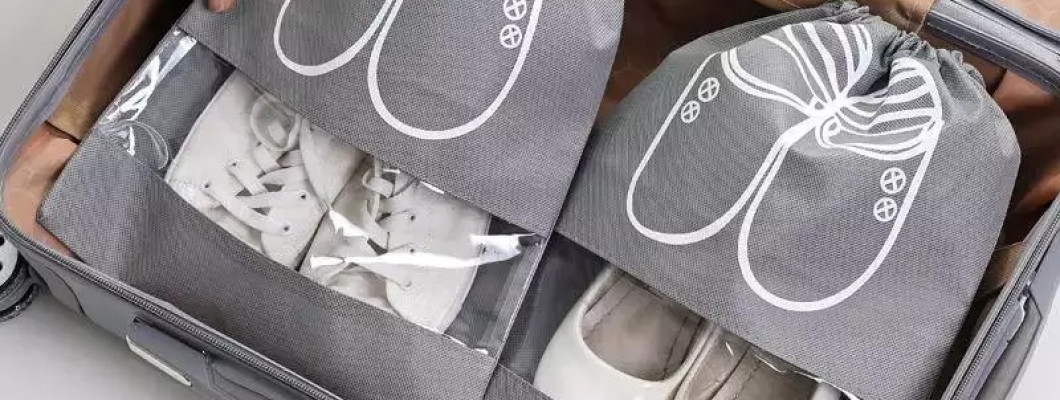
The Travel Shoe Storage Bag with Transparent Window is made from non-woven fabric. The listing specifies a 31 × 43 cm size, a drawstring closure and a lightweight, foldable design.
A transparent window helps identify the footwear inside. The currently listed colour is black, with model W36.
The bag is intended for travel and home storage, including separating shoes from clothing and helping protect them from dust and dirt. You can review the product here:
https://k-m.store/en/travel-shoe-storage-bag
The description mentions light moisture, but this does not establish waterproof construction or suitability for enclosing wet shoes. Odour control, machine washing and a numerical carrying limit are not confirmed.
Prepare Footwear Before Packing
Inspect the soles and sides for visible dirt. Remove it using a method appropriate to the particular footwear rather than applying the same cleaning process to every material.
Make sure the shoes are dry before enclosing them. A storage bag does not make trapped moisture suitable for packing, and the transparent window cannot reveal the condition of every internal area.
Check laces, buckles and protruding details. Arrange them without unnecessary tension or bending, and make sure nothing is likely to snag during insertion.
Damaged or sharp parts need separate attention. Do not use the bag to conceal a problem that could affect its fabric or other belongings.
Test the Fit Before Departure Day
Open the bag and insert the intended footwear gently. Check whether the opening gathers without pulling the fabric tightly against the shoes.
Try an arrangement that preserves their shape. Do not force a toe area or heel into a distorted position simply to complete the closure.
Then reopen the bag and remove the footwear. This second step matters: the bag needs to be usable when you arrive, not just possible to close at home.
Check the window in the packed position too. If it reveals a useful part of the shoes, identification will be easier. If not, reconsider their orientation without compromising fit.
Choose a Suitcase Position That Suits the Contents
There is no single correct location for shoes in every suitcase. The shell shape, compartments, opening style and neighbouring belongings all affect the decision.
Choose a position that accommodates the footwear without pressing it against delicate items. Do not treat the fabric bag as cushioning or impact protection.
Check the complete arrangement with the other essential contents in place. Close the suitcase gently and notice whether the lid or zipper encounters resistance.
If force is needed, redistribute or reduce the contents. A bag can make shoes look organised while the overall suitcase remains overfilled. Neatness and adequate capacity are separate considerations.
Use the Transparent Window Deliberately
The window is most useful when it faces somewhere you can see on opening the suitcase. A window buried beneath other belongings offers less help with identification.
If several pairs look similar, combine the visible contents with a known packing arrangement. Do not rely on a glimpse of colour when another traveller also needs to find the correct footwear.
The window is an identification aid, not a complete inspection method. After wearing the shoes, remove and check them before repacking rather than judging their condition through the clear section.
At home, the same principle applies: visibility can help you find a pair, but it does not replace occasional checks during storage.
Keep Clothing Organisation Separate
Packing cubes and shoe bags can be used together, but they serve different contents. Keep clothing grouped according to your chosen system and footwear in its own suitable cover.
When rearranging the suitcase, lift out the shoe bag as a separate item and place it on an appropriate surface. Avoid emptying used footwear over the clothing and trying to restore separation afterwards.
For a detailed comparison of organising clothes by outfit or by clothing type, see:
https://k-m.store/en/packing-cubes-by-outfit-or-clothing-type
A clear system should remain understandable after changes. If you move the shoes, keep their new location obvious to anyone sharing the luggage.
Short-Trip Example: One Additional Pair
Suppose you wear your everyday shoes for the journey and pack a second pair for a particular occasion. Prepare the packed pair, test the bag and choose a position that allows straightforward access.
Now consider the return journey. You may decide to wear the occasion shoes and pack the original pair instead.
If those pairs differ significantly in bulk, test both before departure. Otherwise, the bag may work for the outward trip but not for the footwear that needs storing on the way home.
This simple check avoids relying on a new packing arrangement at the moment when you have limited time and fewer options.
Shared-Suitcase Example
In shared luggage, each traveller should know which bag contains their shoes and where it belongs. The window helps, but a consistent arrangement adds clarity.
Avoid combining different people’s footwear merely because some space remains. Consider who needs access and whether the shoes can share the available room without pressure.
If one person changes the layout, tell the other where the bag has moved. An organiser cannot solve confusion caused by missing information.
Before closing the suitcase, check that everyone’s footwear is accounted for. This is especially useful when several people are switching between the shoes they wear and those they pack.
Special-Footwear Example
Formal or shape-sensitive footwear may need more than a flexible cover. Check the manufacturer’s storage guidance and consider whether the suitcase arrangement protects its form.
Non-woven fabric is not a rigid shell. Do not assume it prevents crushing from nearby luggage.
If suitable protective supports are recommended for the shoes, account for their space during the fit test. Do not add them after choosing the bag and assume the same capacity remains.
At the destination, unpack in time to review the footwear before the event. Leaving it compressed until the last moment makes it harder to respond if the arrangement was unsuitable.
Check Shoes Again After Wearing Them
Before returning footwear to its bag, repeat the preparation check. Short use does not automatically mean the soles are clean or the shoes are dry.
Remove visible dirt appropriately and allow suitable drying time according to the footwear’s care instructions. Do not rely on this bag to isolate wet shoes from clothing.
If immediate packing is unavoidable, choose a temporary arrangement appropriate to the actual condition and keep it separate from clean belongings. The standard storage bag should not be assumed to provide a sealed wet compartment.
Also inspect the bag’s interior before replacing used shoes with a clean pair.
Reassess Space Before the Return Journey
Souvenirs and other purchases can change the available space even when the shoes have not changed. Review the whole suitcase instead of treating their original position as fixed.
Avoid pushing new objects against the footwear or using the shoe bag as a container for unrelated additions. This can change the fit and make identification less useful.
Close the suitcase without force after rearranging. If you switch the pair you wear for travel, account for the new packed pair’s dimensions.
Check the actual luggage weight when needed. A shoe organiser does not reduce footwear weight or compensate for additional contents.
Use the Bag for Home Storage Thoughtfully
The bag can provide a designated place for suitable footwear between uses. Prepare the shoes first and choose a dry storage location.
Position the window where it helps you identify the pair. If the wardrobe contains similar bags, use a consistent arrangement rather than relying on memory alone.
Check the footwear and bag periodically. A cover is not a remedy for damp conditions in the storage area.
Before taking a home-storage bag on a trip, inspect its fabric, window, stitching and drawstring. Then test it with the actual travel footwear rather than assuming that a previously stored pair proves compatibility.
Follow Confirmed Care Information
The available product page does not provide detailed machine-washing or tumble-drying instructions. Check any supplied care label or ask the store before choosing a full cleaning method.
Empty the bag and inspect the interior before storing it. Avoid sharp tools for removing trapped material and unnecessary pulling on the window or drawstring.
After any permitted cleaning, make sure the bag is dry before reuse. Fold it empty when it is no longer needed, without forcing the transparent section into a damaging bend.
Care needs to suit the complete item, including the fabric, window and closure, rather than assumptions about one material alone.
Avoid These Common Packing Mistakes
Do not choose solely by shoe size or assume a guaranteed number of pairs. Actual bulk and closure space determine practical fit.
Do not describe the bag as waterproof, odour-proof or a compression organiser without confirmation. These are separate functions.
Avoid putting wet footwear away and treating the cover as a substitute for drying. Likewise, do not place a clean pair into an unchecked bag previously used for dirty shoes.
Finally, do not use the drawstring to pull a loaded suitcase or carry extra weight based on an assumed strength. The listing does not provide a numerical load capacity.
Before-You-Pack Checklist
Match each pair to an actual trip activity.
Decide which shoes you will wear during travel.
Measure the footwear rather than relying on labelled size.
Compare the bag’s stated 31 × 43 cm dimensions.
Check pair capacity instead of assuming it.
Remove visible dirt and confirm dryness.
Test insertion, closure and removal.
Choose a position away from unsuitable pressure.
Check the pair likely to be packed on the return trip.
Follow confirmed care instructions.
Quick Answers
To separate shoes: Use a suitably fitted bag with dry, prepared footwear.
To assess size: Consider length, width, height and room for closure.
To find a pair quickly: Keep the transparent window visible where practical.
To repack after use: Inspect both footwear and the bag’s interior.
To handle wet shoes: Do not assume this bag provides waterproof isolation.
To store the empty bag: Use its foldable design after checking that it is clean and dry.
Frequently Asked Questions
1. What does a travel shoe bag do?
It gives footwear a separate place in luggage and helps organise access. It does not clean shoes, reduce their weight or automatically protect them from crushing.
2. What size is the K&M Shopping bag?
The listed size is 31 × 43 cm. Actual compatibility also depends on the footwear’s width, height and the space needed to gather the opening.
3. Will it hold a complete pair?
That depends on the pair’s actual dimensions and arrangement. The listing does not guarantee a fixed capacity in pairs, so check before relying on it for particular shoes.
4. Is it suitable for trainers and formal shoes?
The page identifies different footwear types as possible uses within the available size. Bulky soles, structured uppers and delicate shapes still require individual assessment.
5. Is the bag waterproof?
Waterproof construction is not confirmed. The reference to light moisture does not establish sealed protection or make the bag suitable for enclosing wet footwear beside clean clothing.
6. Does it prevent shoe odours?
No odour-control feature is confirmed. Follow the footwear’s care requirements and do not use the bag as a substitute for appropriate cleaning and drying.
7. Can you identify the contents without opening it?
Yes, the transparent window helps with identification. Its usefulness depends on the packed orientation, and it does not reveal every part of the footwear for inspection.
8. Can it go in a washing machine?
Machine washing is not confirmed in the available description. Follow a supplied care label or ask the store before machine washing, tumble drying or using strong cleaners.
9. Can it be used in a wardrobe?
Home storage is a listed use. Store suitable clean, dry footwear in an appropriate location and review its condition rather than treating the bag as a solution for damp surroundings.
10. Does it create extra luggage capacity?
It is not described as a compression or vacuum bag. It helps organise shoes, but does not shrink their soles, reduce weight or guarantee more suitcase space.
Test One Pair Before Committing to the Layout
Prepare the pair you intend to pack, check the bag’s fit and place it in the suitcase with the other essential items. Test the complete closure without force.
If the arrangement does not work, change the footwear selection, position or storage method before departure day. Do not let an organiser become a reason to carry an unnecessary extra pair.
Review the product here:
https://k-m.store/en/travel-shoe-storage-bag
For other products available from K&M Shopping, visit:
Practical shoe packing remains clear in both directions of the trip. Choose the footwear deliberately, separate it appropriately and check the arrangement again whenever the contents or the shoes you are wearing change.
Leave a Comment