
How to Keep Grocery Bags from Sliding in Your Car Trunk: A Practical Loading Guide
How to Keep Grocery Bags from Sliding in Your Car Trunk: A Practical Loading Guide
You finish shopping, arrange the bags in your trunk, and head home. When you open it again, a small purchase has disappeared behind another bag, several items have changed places, and unloading takes longer than expected.
A better trunk setup starts before you load the car. Bag choice, packing order, available space, and the way you plan to unload all affect how manageable your groceries will be. An organizer can help with a specific problem, but it works best as part of a sensible routine.
This guide explains how to plan that routine, choose between different organizing approaches, and decide whether a grocery stabilizer barrier suits your needs. The aim is a practical arrangement you can repeat on an ordinary shopping trip, without turning your trunk into a complicated storage system.
Quick Answer
To help keep grocery bags organized, pack them thoughtfully, give each group a defined place, and choose an organizing method suited to your vehicle and purchases. A tidy layout should also make unloading straightforward. Keep packaging, food storage requirements, and appropriate cargo securing in mind throughout the process.
Contents
Identify what actually goes wrong.
Check the usable space in your trunk.
Pack for the journey and the unloading.
Choose an organizing approach.
Consider a grocery stabilizer barrier.
Plan different shopping trips.
Avoid common loading mistakes.
Build a simple reset routine.
Use the departure checklist.
Read the quick answers and FAQs.
Follow the step-by-step starting plan.
Identify What Actually Goes Wrong
“Groceries move around” can describe several different problems. A bag may change position, its contents may shift inside it, or a small item may simply become difficult to find. These situations call for different adjustments.
Think back to your last inconvenient trip. Did you have to reach deep into the trunk? Did several purchases end up in an unrelated bag? Did a package get squeezed because there was no suitable place for it?
Write down the most noticeable problem in one sentence. For example: “Small household purchases get lost among the food bags.” That points toward grouping those purchases together. “I cannot reach the bag I need first” suggests changing the loading order.
This approach makes it easier to evaluate an accessory. You know the job it needs to do, and you can judge whether it improves that job after a normal trip.
Check the Space You Actually Use
Open the trunk when you have time to look at it properly. Separate its contents into things that belong there, things needed for an upcoming journey, and things that should return to the house.
A reusable shopping bag is useful only when you can find it. An empty delivery box may be taking up the exact area you need for groceries. Removing forgotten items can reveal more usable space than rearranging them repeatedly.
Next, consider the opening as well as the floor. A container might fit inside but be awkward to lift through the opening when packed. Think about the complete movement: placing it in the car, reaching its handles, and lifting it out.
Keep access requirements in mind, too. Follow your vehicle manual when arranging belongings around equipment, storage compartments, and other features you may need to reach.
Pack for the Journey and the Unloading
Packing is easier when you know where each group will go after arriving home. You might separate pantry purchases, household supplies, and items that need prompt attention according to their storage instructions.
This does not require a different bag for every category. The purpose is to create useful groups that you can identify without opening everything.
Inspect reusable bags before shopping. Check their handles, seams, and cleanliness, and follow any care instructions. Set aside a damaged bag instead of discovering its weakness while carrying purchases from the car.
Avoid filling a bag simply because space remains inside it. Consider whether you can comfortably handle the completed load and whether the contents have suitable protection. A manageable bag is more useful than a tightly packed one that must be unpacked before you can lift it.
Give Small Purchases a Clear Home
Small purchases are easy to overlook when mixed with large packages. A cable, stationery item, or kitchen accessory can disappear into the bottom of an otherwise ordinary grocery bag.
Choose a small bag or suitable container for these purchases, and keep it recognizable. You could use the same reusable bag each time or keep the relevant receipt with the group.
The benefit appears during unloading. Instead of checking every grocery bag for one missing item, you know where that category belongs.
This is particularly helpful when shopping for more than one person. Grouping purchases by recipient can prevent an item intended for a relative or neighbor from being carried into your kitchen and forgotten.
Choose an Organizing Approach
Start with the task rather than a product category.
If several small objects need to travel together, a suitable container may make handling easier. If you need to separate purchases for different destinations, distinct bags may be enough. If your current arrangement lacks a useful boundary, a compatible divider may be worth considering.
Think about how often the setup must change. A regular weekly shop may suit a familiar arrangement, while a car used for varied errands needs flexibility.
Also consider what happens when the organizer is empty. Where will it go? Will it occupy space needed for another task? Can the next person using the car understand the arrangement?
An accessory earns its place when it makes a recurring task easier. Adding several pieces without assigning each a clear purpose can make loading more complicated.
A Grocery Stabilizer Barrier to Consider
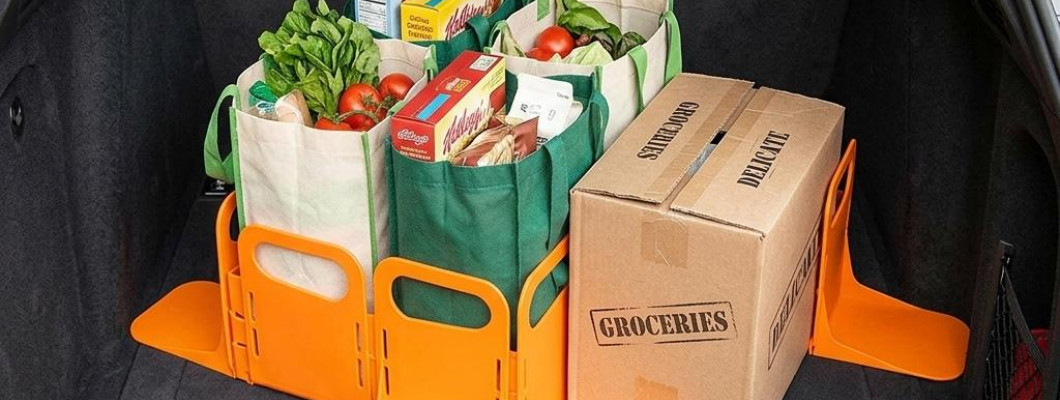
K&M Shopping offers a Car Shopping Bag and Cargo Stabilizer Barrier for compatible carpeted trunk floors. It uses an underside grip and requires no drilling, adhesive, or tools.
The listed dimensions are approximately 19 × 14 × 11.5 cm, with a stated measurement tolerance of ±1 cm. Each ordered quantity contains one barrier. Grey is the only currently available color.
Product details:
https://k-m.store/shop/en/accessories/car-cargo-stabilizer-barrier
To use it, check carpet compatibility, position the base, press it into place, and place the upright side beside the intended lightweight cargo without squeezing the packaging. Check the arrangement manually while parked.
The exact material and a numerical load rating are not specified. It is an organizational aid, not a certified restraint for heavy cargo. Do not assume compatibility with a rubber or smooth liner.
Make a Purchase Decision Before Checkout
Before buying any organizing accessory, compare its stated requirements with the place where you intend to use it. Check the surface, available footprint, and the items you normally carry.
Read the quantity information carefully. A demonstration image may show an arrangement involving multiple pieces, while the selling unit may be different. Build your plan around what the listing actually includes.
Avoid using photographs to estimate performance. A picture can explain a layout, but it cannot establish an unlisted load capacity, durability rating, or universal fit.
If an important detail is missing, ask the retailer before ordering. A short compatibility question is more useful than buying around an assumption and trying to adapt the product afterward.
Plan a Small Top-Up Shop
For a short shopping trip, keep the arrangement simple. Before leaving, take the bags you expect to need and clear a suitable area for the purchases.
At the checkout, group items so you can identify them later. An unplanned household purchase should not disappear among ingredients for dinner.
When loading, think about the first task at home. If you will carry one bag straight to the kitchen and another elsewhere, keep those groups distinct.
After unloading, check whether the arrangement solved the problem you identified. If the trip was easy to manage, keep that approach. There is no need to add more equipment just because unused trunk space remains.
Plan a Larger Weekly Shop
A weekly shop requires more attention to sequence. Start with an estimate of the types of purchases you expect, including any unusually shaped packages.
Leave room for variation. Your list may change, or a package may be larger than expected. If the actual purchases do not fit your original arrangement, pause and revise it before driving.
Consider the people helping you unload. A layout that depends on one person remembering every bag can become confusing. Clear groups make it easier to explain what should go where.
At home, deal with purchases according to their storage needs. Trunk organization does not provide temperature control or change the handling instructions on food packaging. Plan the trip and suitable transport arrangements accordingly.
Plan Several Stops
When a journey includes multiple stores or deliveries, organize by destination as well as product type.
For example, purchases for a family member should remain separate from your own groceries. Otherwise, you may need to search through the entire load at the first stop.
Before leaving each location, reconsider what has changed. Removing one group can leave a different arrangement behind. Adding a bulky purchase can also affect access to things already packed.
Make adjustments only while parked in a suitable place. Do not reach back to rearrange shopping while driving. If something needs attention, stop safely before dealing with it.
Keep a Shared Car Easy to Understand
A trunk arrangement should make sense to everyone who uses the vehicle. If another driver has to dismantle your setup before running an errand, it may need simplifying.
Agree on what stays in the car and what should be removed after each trip. Give reusable shopping bags a predictable home, and keep the main shopping area available.
A photo of the ordinary setup can be useful when explaining it. It shows where things belong without requiring labels on every surface.
Review the arrangement when routines change. School activities, work equipment, and weekend plans may all affect the space required. A useful setup can adapt without becoming a permanent collection of unrelated belongings.
Avoid These Common Mistakes
Buying before checking the trunk
Measure and inspect the actual space first. An accessory that looks convenient online may not suit your loading habits or the surface in your vehicle.
Treating appearance as proof of suitability
Neatly aligned bags can still contain poorly packed purchases. Check the contents and packaging as well as the overall layout.
Keeping the same arrangement for every trip
A small food shop and a collection of household supplies may need different grouping. Let the purchases determine the arrangement.
Using every available gap
A tightly filled trunk can make unloading awkward. Preserve the access you need to handle each group sensibly.
Ignoring the end of the journey
The job continues after parking at home. A useful setup supports carrying, checking, and putting away purchases, not just placing them in the car.
Rethink the Setup When It Is Awkward
If an arrangement feels inconvenient, identify the exact point where it becomes difficult.
Perhaps you can load a container easily but cannot reach its handles afterward. Perhaps your reusable bags are stored behind something that must be removed every time. Those are access problems, so begin by changing access.
If a purchase is difficult to accommodate because of its shape or handling requirements, plan for that item separately. Do not force unusual cargo into a grocery arrangement simply because you already have one.
Follow vehicle guidance and appropriate instructions for securing loads. Ordinary shopping organization should never be treated as evidence that an arrangement is suitable for every object or driving condition.
Build an After-Shopping Reset
Once the purchases are indoors, return to the car for a brief check. Look for forgotten bags, receipts, packaging, and items intended for another destination.
Remove anything that no longer belongs there. Put reusable bags away only when they are clean and ready for use, following their care instructions.
Then restore the space you expect to need on the next trip. This is easier than postponing the task until you are standing beside a full shopping trolley.
Keep the reset short enough to repeat. A practical routine should reduce future effort, not create a detailed cleaning project after every errand.
Review the Arrangement Each Week
Choose a convenient point in the week to ask three questions: What stayed in the trunk unnecessarily? What was difficult to reach? What purchase did the arrangement fail to accommodate?
Use the answers to make one useful change. Moving the bag storage location or changing how you group small purchases may be enough.
If you need an additional accessory, browse with that specific task in mind. You can explore K&M Shopping here:
https://k-m.store/
Assess the change over ordinary use. Keep what helps, and remove elements that add handling without solving a problem. The aim is a repeatable routine that suits your household.
Before-You-Drive Checklist
Bags and packaging are suitable for their contents.
Purchases with different handling needs are appropriately separated.
Small items have an identifiable place.
The unloading order is clear.
Accessories are used according to their instructions.
Cargo securing follows the relevant vehicle and equipment guidance.
The trunk closes without pressing against the purchases.
All adjustments are complete before driving.
Quick Answers
Best starting point: Describe the recurring problem before choosing an accessory.
Most useful packing habit: Group purchases in a way that makes sense at your destination.
What to check before ordering: Compatibility, dimensions, included quantity, and stated limitations.
When to change the layout: Whenever the purchases or the vehicle’s daily role change.
How to judge success: Look at loading, access, unloading, and the ease of preparing for the next trip.
Frequently Asked Questions
Should I organize groceries by store or by category?
Choose the method that supports your next task. Sorting by category may help when putting groceries away at home. Sorting by destination is useful when delivering purchases to different people. Store-based grouping can help when you need to keep receipts and purchases together.
Is one large shopping bag better than several smaller bags?
Neither arrangement is automatically better. Consider handling, packaging, and the contents. Choose groups you can manage comfortably without cramming unrelated items together. The right number of bags depends on the actual purchases and how you will carry them indoors.
How can I stop forgetting small purchases in the car?
Give small purchases a recognizable group and check that group during unloading. Then make a final visual check of the trunk. A consistent place for miscellaneous items is easier to remember than searching whichever bag happened to have room.
Do I need a separate layout for every shopping trip?
You can keep a basic arrangement while adapting it to the current purchases. Think of the usual setup as a starting point. Change it when package shapes, quantities, destinations, or access requirements differ from your normal routine.
What should I check when using reusable shopping bags?
Inspect their condition and cleanliness, including handles and seams. Follow the care instructions and replace bags that are no longer suitable. Also consider whether the bag’s shape and opening make it convenient for the purchases you plan to carry.
Can I judge an organizer’s suitability from its pictures?
Pictures can help explain appearance and intended placement, but they do not confirm missing specifications. Read the product information and check it against your vehicle. Ask about details that matter rather than inferring them from a demonstration photograph.
What if my trunk setup works for me but confuses another driver?
Simplify the arrangement together. Agree on permanent contents, shopping space, and where empty bags belong. A shared routine should be understandable without one person supervising every trip. Review it whenever either driver’s needs change.
Should I keep empty boxes in the trunk for future shopping?
Keep a container only if it has a useful, suitable role. Empty boxes can gradually consume the space needed for purchases. Check their condition and decide whether keeping one genuinely helps your routine or merely postpones tidying.
How do I evaluate a new organizing accessory?
Choose one task you expect it to improve, such as separating purchase groups or making unloading easier. After ordinary use, assess that task. Do not create abrupt driving maneuvers to test an accessory or assume a neat appearance proves effective cargo restraint.
When is it time to replace my whole arrangement?
Reconsider the setup when it repeatedly interferes with loading, leaves purchases difficult to reach, or no longer matches how the car is used. Start with current needs and reusable items you already own before deciding what else is necessary.
Start Here: A Step-by-Step Plan
Step 1: Clear the shopping area
Remove unrelated belongings and keep required vehicle equipment accessible according to the manual.
Step 2: Name the problem
Choose one recurring inconvenience to address on the next trip.
Step 3: Prepare suitable bags
Inspect them and plan sensible groups for the expected purchases.
Step 4: Check any accessory requirements
Confirm that the intended setup matches the product instructions and your vehicle.
Step 5: Load for your destination
Consider who will unload and which purchases need attention first.
Step 6: Review while parked
Check packaging, access, and appropriate securing before setting off.
Step 7: Reset after unloading
Remove leftovers, restore the shopping space, and note one useful improvement.
Conclusion
A manageable grocery load begins with thoughtful packing and a clear plan for the space available. Accessories are most useful when you choose them for a specific job and understand their requirements.
Build a routine around your real shopping habits. When loading, finding, and unloading purchases become straightforward, the arrangement is doing useful work.
Quick Summary
Identify the recurring inconvenience.
Plan around usable trunk space.
Group purchases for their destination.
Verify accessory requirements before buying.
Keep handling and securing needs separate from appearance.
Reset the trunk after each shopping trip.
Read Also
Preparing luggage for a journey as well as organizing everyday purchases? Read the guide to weighing luggage at home:
https://k-m.store/shop/en/blog/how-to-weigh-luggage-at-home
Leave a Comment