
How to Choose an Egg Holder: Kitchen Space, Everyday Use and Storage Planning
How to Choose an Egg Holder: Kitchen Space, Everyday Use and Storage Planning
An egg holder can make a kitchen look organised, but appearance is only one part of choosing a useful accessory. The holder needs to fit your available space, accommodate the eggs you buy and remain convenient when you are actually preparing a meal.
There is also an important distinction between arranging eggs and storing them appropriately. A decorative stand does not change the storage requirements printed on the egg carton, and an attractive display is not a reason to leave refrigerated food on the counter.
Before choosing a holder, decide what you want it to improve. You might want somewhere to arrange ingredients during preparation, a decorative kitchen feature or a clearer way to plan quantities for a recipe.
This guide explains how to assess those needs, check dimensions and establish a practical routine without confusing organisation with food preservation.
Quick answer
Choose an egg holder by checking its dimensions, opening compatibility, stability and ease of cleaning. Allow enough space around it to pick up eggs comfortably and use nearby kitchen equipment.
Follow the storage instructions on your egg packaging. For refrigerated eggs, FDA guidance recommends keeping them in their original carton in the refrigerator. A stand provides organisation, not refrigeration or an extension of shelf life.
Contents
Define the job you want the holder to do
Separate display from food storage
Choose capacity without overbuying
Measure the space and test access
Check compatibility and handling
Plan quantities and keep carton information
Use the holder during meal preparation
Establish cleaning and review habits
Checklist and quick answers
Frequently asked questions
Define the job before choosing the design
Start with a specific problem rather than a general wish for a tidier kitchen.
Perhaps you regularly count out eggs while baking and want a designated place for the ingredients you are about to use. Perhaps you like a decorative stand but need to know whether it will crowd your worktop.
Alternatively, your real difficulty may be forgetting how many eggs remain before shopping. That problem might be better addressed with a simple stock note.
Knowing the job helps you judge whether a holder adds value or introduces another object to move around.
Separate an organised display from appropriate storage
A stand can arrange eggs visibly, but visibility does not establish whether their storage conditions are suitable.
Keep your food-storage routine anchored to the carton instructions and applicable safety guidance. Do not move your regular refrigerated stock onto a countertop merely to complete a decorative arrangement.
For preparation, take out the quantity you need when you are ready to begin. Keeping the rest in its appropriate storage location avoids turning a short cooking task into a permanent countertop display.
An air-conditioned kitchen should not be treated as a substitute for required refrigeration.
Keep the original information available
The carton carries information you may need after the shopping trip, including storage directions, date markings and product details.
Discarding it immediately can make those details harder to recover. Remembering when you bought the eggs is not the same as retaining the information supplied with them.
This matters particularly when different household members shop or when more than one carton is in use.
Keep each batch associated with its original information. A neat arrangement should make kitchen management clearer, not leave you guessing which purchase a particular group came from.
Choose capacity around your routine
Maximum capacity is a limit, not a target you need to reach.
A larger holder may suit someone preparing several recipes, but it may be unnecessary for a household using only a small quantity at a time. Consider how frequently you cook with eggs and what you intend to arrange during each task.
Also consider whether you have enough working space to leave the holder in a useful position.
A product with fewer occupied openings can still be doing its job. There is no practical reason to buy additional eggs simply to make the arrangement look complete.
Do not turn empty openings into a shopping list
Storage accessories can subtly influence shopping decisions. An empty position may look like something that needs replenishing even when you already have enough food for your plans.
Build the shopping list from meals and existing stock instead.
First identify what you expect to cook. Then check the eggs already available and their carton information. Only after that should you decide what to buy.
This separates the visual appeal of a full organiser from the actual needs of the kitchen. It also allows the holder to serve occasional preparation without determining your purchasing routine.
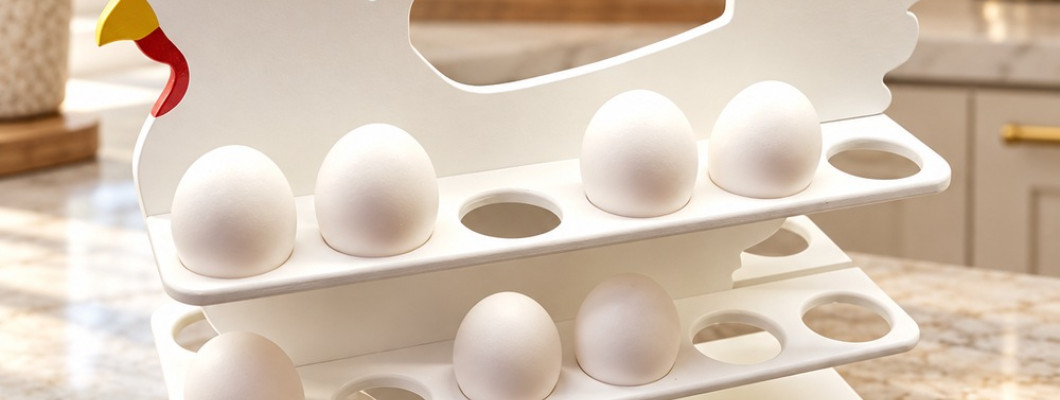
A chicken-shaped holder from K&M Shopping
The Chicken Egg Holder Stand from K&M Shopping has two tiers and individual openings. Its stated capacity is up to 24 eggs, depending on egg size and compatibility.
The listed dimensions are approximately 30 × 13 × 25 cm. An upper carrying opening is provided, and the base should be supported when moving the stand.
You can review the product here:
https://k-m.store/shop/en/chicken-egg-holder-stand
The exact material and dishwasher compatibility are not confirmed. Use the verified measurements and layout to assess suitability rather than making assumptions from photographs.
Measure the footprint in a real working area
Choose a possible location and compare its available length and depth with the holder’s dimensions.
Then assess what remains around it. Can you still place a mixing bowl where you normally work? Is there room for a chopping board? Will you need to move the stand whenever you open a drawer?
A simple paper outline can help you visualise the footprint before buying. Place it on the intended surface and go through the motions of preparing an ordinary meal.
If the outline is repeatedly in the way, consider another location.
Allow space above the holder
Fitting beneath a cupboard is not the same as being comfortable to use there.
You need room for your hand to approach, grasp an egg and lift it out without contacting the shelf above. The same applies beside tall appliances or containers.
Imagine reaching the most awkward opening, not just the nearest one. If that movement requires tilting the stand or lifting it out each time, the location needs reconsideration.
There is no universal clearance that works for every hand and kitchen layout. Test the movement rather than relying only on the external height.
Judge the space left for cooking
Kitchen accessories compete with preparation tasks for the same surface.
Before allocating a permanent position, consider a complete cooking sequence: bringing out ingredients, mixing, handling utensils and clearing up. An organiser is useful only if it supports that sequence.
In a small kitchen, an occasional preparation tool may be better stored between uses than kept on the counter continuously.
This does not make it less useful. It simply means its value comes from the task it performs rather than the amount of time it remains on display.
Inspect and position the empty holder first
When the holder arrives, begin with it empty.
Place it on the intended surface and check whether it sits steadily. Look at the surrounding objects and test access without adding fragile contents.
Move it away and return it to the same position. This can reveal whether the location is practical or whether you have chosen a narrow gap that requires careful manoeuvring every time.
If the stand does not sit properly, investigate the surface or the product before loading it. Adding eggs is not a way to correct an unstable setup.
Test egg compatibility gently
Try a limited quantity during an actual preparation task before using more openings.
Check whether each egg rests naturally and can be removed without force. Do not assume that a capacity figure guarantees compatibility with every egg size.
Pay attention to your grip as well as the fit. An opening may hold an egg, but the surrounding arrangement should still allow you to lift it without knocking another one.
If an egg does not fit comfortably, use an appropriate alternative. Leave the opening unused rather than forcing the match.
Plan movement before lifting
A useful location should minimise the need to carry a loaded stand between appliances and bowls.
When movement is necessary, clear the destination first. Do not lift the holder and then search for somewhere to put it down.
Use the handling method specified for the product, including supporting the base. Avoid treating a carrying opening as proof that every movement or load arrangement is suitable.
An open display stand also serves a different purpose from protective transport packaging. Keep that distinction in mind when bringing groceries home or carrying food elsewhere.
Use a stock record independent of the display
If your main goal is knowing how many eggs remain, choose a record you can maintain easily.
A note on your phone or a line on the weekly meal list may be enough. Update it at a useful checkpoint, such as when planning the next shopping trip.
You do not necessarily need to log every egg throughout the day. A system that becomes tedious is unlikely to last.
Count the actual stock where it is stored. Do not use the holder’s available capacity as a substitute for knowing what you have.
Calculate what is already committed to recipes
Imagine you have eight eggs available. One planned recipe needs three and another needs two. That leaves three not yet allocated.
This is a planning example, not a statement about freshness or storage duration.
The distinction between “in the kitchen” and “available for another meal” is useful. A quick visual count might suggest plenty of stock, while several eggs are already needed for a planned baking session.
Writing down those commitments makes the shopping decision clearer without requiring you to move the eggs out of their cartons.
Keep different batches distinguishable
Combining eggs from separate purchases may create a consistent-looking display, but it can also separate them from their information.
Avoid arrangements that leave you unable to tell which batch belongs to which carton. Follow the relevant dates and storage directions when planning use.
Do not assign an older batch the information from a newer purchase simply because they now occupy the same organiser.
A kitchen system does not need to look perfectly uniform to work well. Clear information is more useful than a display whose contents are difficult to identify.
Example: a weekday breakfast
Decide what you are making and how many portions are needed before taking out ingredients.
Arrange the quantity required when preparation begins, leaving room for the cooking equipment and serving dishes. If you use a holder, place it where it does not interrupt those movements.
At the end, clear the preparation area rather than leaving extra ingredients out to maintain the arrangement.
The useful question is whether the holder made the task easier. If it added unnecessary transfers on that occasion, keep the routine simpler next time.
Example: two recipes being prepared together
When baking and cooking at the same time, identify the quantity needed for each recipe before starting.
Write those amounts beside the recipe names or agree on them with anyone helping. A visible arrangement can support the process, but position alone is not a reliable label if someone else moves an ingredient.
Keep the preparation sequence clear: which recipe starts first, which ingredients are needed now and which can remain stored until later.
This reduces confusion without depending on a fully loaded stand or a complicated tracking method.
Example: a shared household kitchen
One person may organise the food while another shops and a third prepares breakfast. A system based only on the organiser’s memory will quickly become unclear.
Agree on where stock is kept and when it is checked. If a quantity is reserved for a planned recipe, record that on the meal list.
Make the arrangement understandable without a long explanation. A visible note saying that ingredients are allocated to tomorrow’s baking is more useful than expecting everyone to interpret a particular row of openings correctly.
Let decoration remain optional
If you enjoy the chicken-shaped design, you do not have to keep real eggs in it continuously.
An empty stand can remain part of the kitchen arrangement when space allows, or it can be stored until needed for preparation.
This separates the decorative choice from food-storage decisions. You can appreciate the design without buying extra stock or changing appropriate refrigeration habits.
Kitchen accessories are most useful when they adapt to your routine. Your routine should not need to revolve around keeping an accessory permanently filled.
Clean with the confirmed instructions
Remove the contents before cleaning and follow the product’s care guidance. Do not infer tolerance for dishwasher cycles, soaking or strong cleaning products from its appearance.
If raw egg leaks, address the affected area promptly rather than covering the residue with another egg. FDA guidance advises washing hands, utensils and work surfaces appropriately after contact with raw eggs.
Make cleaning access part of your original placement decision. A holder that is easy to remove and inspect is more practical than one wedged into a crowded arrangement.
Review the routine before shopping
During the weekly shopping review, check actual quantities, carton information and upcoming meals.
Also ask whether the holder is earning its place. Are you using it for a clear task? Does it remain accessible? Has another appliance made the original location less convenient?
Seasonal baking or entertaining may change your needs temporarily. Plan those extra quantities around recipes and suitable storage space, then return to your ordinary routine afterward.
Occasional high demand should not automatically become a reason to keep buying more every week.
Common mistakes to avoid
Choosing by appearance without measuring the space.
Checking the footprint but forgetting hand clearance.
Assuming every egg size fits.
Filling empty openings merely for a complete display.
Losing the original carton information.
Mixing batches without a clear way to distinguish them.
Treating an open stand as protective transport packaging.
Assuming an organiser provides refrigeration or longer shelf life.
Before-use checklist
Define the task you want to improve.
Confirm the appropriate food-storage routine.
Measure the intended location.
Leave room for hands and neighbouring equipment.
Check the empty stand for stable placement.
Test compatibility without force.
Keep batch information available.
Follow confirmed care instructions.
Review the benefit after several actual uses.
Quick answers
Best capacity: the one suited to your task and available space, not necessarily the largest.
Reason to leave openings empty: your current preparation does not require more eggs.
Useful stock check: count what is available and subtract quantities already allocated to recipes.
Reason to choose another arrangement: the holder crowds the workspace, complicates handling or conflicts with proper food storage.
Frequently asked questions
How do I choose an egg holder for a small kitchen?
Measure the footprint and check the space needed to reach each opening. Consider whether occasional use followed by storage would work better than a permanent countertop position.
Does an egg holder replace refrigerated storage?
No. It organises eggs but does not cool them. Follow the carton instructions and appropriate food-safety guidance.
Will every egg size fit?
Not necessarily. Compatibility depends on the openings and the eggs themselves. Test gently and never force an egg into position.
Do I need to fill the entire holder?
No. Use only the quantity relevant to your task. Empty openings do not mean you need to buy more.
Can appearance tell me whether an egg is safe?
Do not rely on appearance alone. Keep the original information and follow the required handling and storage conditions.
Should I discard the carton after arranging eggs?
Keep the carton information available. For refrigerated eggs, retaining the original carton in the refrigerator is the recommended storage approach described earlier.
Is this stand dishwasher-safe?
That compatibility is not confirmed on the product page. Follow the available care instructions instead of assuming a particular cleaning method is suitable.
Can I use it to transport eggs from the shop?
Do not treat an open display stand as protective shopping packaging. Use suitable transport packaging for that task.
How should I manage two different purchases?
Keep each batch associated with its own information. Avoid mixing them in a way that makes dates or instructions unclear.
How can I tell whether the holder is useful?
Assess whether it makes a real preparation task easier without crowding the kitchen or creating unnecessary transfers. Practical benefit matters more than keeping it full.
Step by step: start with one task
Choose one meal-preparation task to improve. Review storage requirements, measure the location and inspect the empty holder.
Test a suitable quantity during preparation, keep carton information available and follow the care instructions afterward.
After several uses, assess access, space and cleaning. Adjust the arrangement if it creates more work than it saves.
Conclusion
A useful egg holder fits both your kitchen and your routine. Capacity and design matter, but so do working space, comfortable handling and clear stock information.
Choose it as an organisation accessory, while keeping food-storage decisions grounded in the requirements of the eggs you buy.
Quick summary
Define the purpose, measure the space and test compatibility. Keep carton information, plan purchases around meals and distinguish preparation from long-term storage. A holder should simplify a task without creating new assumptions about food safety.
Read also
For another approach to organising food portions, explore the vacuum food storage bags guide:
https://k-m.store/shop/en/blog/vacuum-food-storage-bags-portion-freezer-guide
For kitchen accessories and other practical products, visit K&M Shopping:
https://k-m.store/
Leave a Comment