
How to Water Plants While Away: A Practical Guide to Testing Watering Spikes
How to Water Plants While Away: A Practical Guide to Testing Watering Spikes
Packing for a trip can reveal a gap in your usual plant-care routine. You know what to check when you are home, but you may not know how to transfer those decisions to a watering device or someone helping while you are away.
A bottle of water beside a plant can look reassuring. However, the useful questions are more specific: is water reaching the intended area, does the arrangement suit this plant, and what happens if the result changes?
This guide explains how to test a watering spike before relying on it. It covers preparation, observation, troubleshooting, and a clear handover plan, without assuming that a stated bottle capacity guarantees a particular number of days.
Quick Answer
Test a watering spike with the same plant, pot, and location you intend to use during your absence. Follow the supplied instructions and observe the water supply, potting mix, drainage, and stability together.
Do not judge success from an empty or full bottle alone. Record what happens and arrange backup care if the trial does not support your travel plan.
A watering device can help deliver water, but choosing an appropriate arrangement still depends on the plant and its growing conditions.
Contents
Define the problem you need to solve.
Understand the device’s limits.
Prepare a plant-by-plant record.
Run a realistic trial.
Interpret the observations.
Handle unclear results.
Prepare a helper and backup plan.
Review daily and seasonal changes.
Use the departure checklist.
Read the frequently asked questions.
Start with the Care Gap
Before choosing equipment, identify what will be missing from your normal routine.
Perhaps you regularly inspect your plants but will be away for a trip. Perhaps a helper can visit occasionally but needs straightforward instructions. Or perhaps you are usually home and want a more manageable way to organize checks.
These situations call for different plans. A device trial may address one part of the problem, while a written care note or an agreed visit handles another.
Describe the goal in one sentence. For example: “I want to understand whether this arrangement supports this pot between planned checks.” A specific goal is easier to evaluate than a general hope that every plant will look after itself.
Understand What “Self-Watering” Tells You
The term describes a category of watering products, not a universal set of capabilities. Check the actual operating method and specifications of the item you are considering.
A gravity-fed device should not be assumed to contain a moisture sensor, timer, or electronic control. Likewise, the appearance of a component does not establish a calibrated adjustment range.
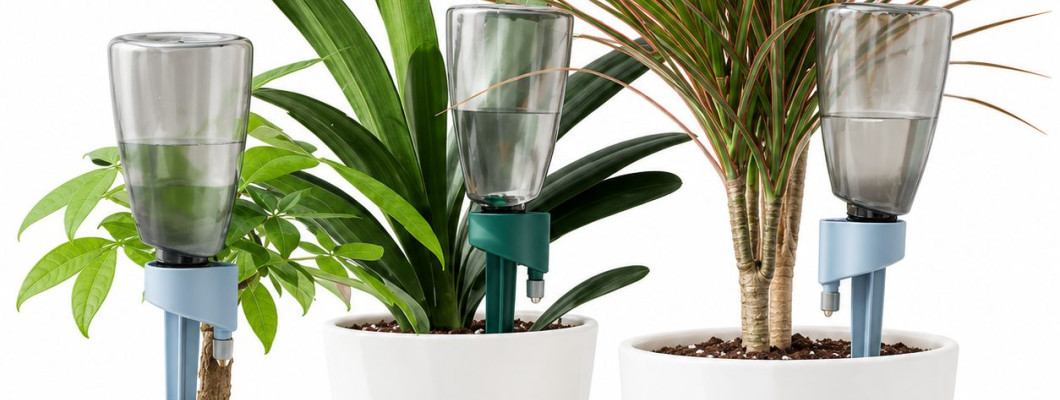
K&M Shopping’s listed system includes a 450ml bottle and delivers water by gravity without electricity or batteries. A dedicated flow-adjustment mechanism and fixed operating duration are not confirmed.
You can review the product information here:
https://k-m.store/shop/en/450ml-self-watering-plant-irrigation-spikes
Use those confirmed details to frame your trial. Keep unverified capabilities out of your travel plan.
Make a Short Record for Each Pot
Give every pot a recognizable name or identifier. “Plant by the bedroom window” may work if its location is unique; numbered labels may be clearer when several pots look similar.
Record the plant’s identity if known, its usual location, and the care guidance you follow. Add any recent changes, such as repotting or relocation.
Leave space for the trial start, observations, and actions taken. A phone note or simple paper record is enough.
Separate known facts from unanswered questions. If you do not know the plant’s basic watering requirements, identify those before deciding whether gradual water delivery is appropriate. Equipment cannot resolve an uncertainty about the plant itself.
Use Plant Needs as the Starting Point
Plants do not all need the same watering pattern. Potting media, temperature, humidity, and species influence the appropriate care.
University of Maryland Extension advises assessing need rather than watering every plant on a fixed schedule. It also notes that wilting can occur with both underwatering and overwatering.
Check moisture in a way suited to the plant and potting mix; surface appearance alone is an incomplete guide. Cacti and succulents require particular attention to their species-specific needs.
Use a reminder to prompt inspection, not an automatic instruction to add water. This distinction remains useful whether you water by hand or are evaluating a device.
Test the Arrangement You Will Actually Leave
A trial is most useful when it resembles the intended period of absence.
Use the planned location and note any expected changes to curtains, room use, or other household arrangements. If the plant will be moved before you leave, the original trial does not fully describe the new situation.
Avoid grouping all plants somewhere convenient without checking whether that location suits them. Accessibility matters, but so do their individual growing requirements.
Write down the conditions you are testing rather than relying on memory. If something changes later, you can identify which observations may need checking again instead of treating the entire trial as universally applicable.
Check the Pot and Surroundings
Confirm that the pot drains appropriately and that excess water is not left standing around its base. Poor drainage and overwatering can contribute to root problems.
If the growing pot sits inside a decorative cover, make sure you can inspect what collects underneath. A tidy outer appearance can hide a problem.
Also assess access. You should be able to inspect the arrangement without repeatedly knocking or repositioning it.
Choose a setup that lets you notice unintended water escape during the trial. Resolve any existing drainage or stability concern before treating a watering spike as the answer to a missed-care problem.
Begin from a Known Condition
Record the pot’s condition before installation and when it was last watered. If another household member helps with plant care, confirm what they have already done.
Do not begin with an unexplained problem and assume the device will correct it. A struggling plant may need assessment before a new watering method is introduced.
Where practical, avoid combining several optional changes at once. Moving the plant, changing its potting mix, and installing equipment together makes later observations harder to interpret.
Necessary care should still happen. Simply document it so that you do not attribute every subsequent change to the watering spike.
Step-by-Step: Set Up the First Trial
Step 1: Read the supplied instructions
Match the parts to the instructions for the version you received. Ask the retailer about any mismatch.
Step 2: Prepare the system
Fill with clean water and assemble as directed. Do not assume compatibility with alternative bottles.
Step 3: Position carefully
Insert the watering tip without forcing it against roots, and check stability.
Step 4: Observe delivery
Confirm that water reaches the intended soil area rather than escaping elsewhere.
Step 5: Record the start
Note the time, water level, pot condition, and any action taken. Keep checking while you are available to intervene.
Watch Three Things Together
Observe the water supply, the potting mix, and the surrounding area as connected parts of the trial.
A falling bottle level tells you that water has left the reservoir. It does not, by itself, show whether the plant received an appropriate supply.
A bottle that appears unchanged is also incomplete evidence. You still need to establish whether delivery is occurring.
Look for a consistent explanation across your observations. If one detail does not fit—such as water appearing outside the intended area—investigate it before calling the trial successful.
This approach is more useful than concentrating on a single visible feature and assuming the rest of the arrangement is behaving correctly.
Write Observations, Not Just Conclusions
“Working well” is difficult to interpret later. A short factual note gives you something concrete to review.
For example, record whether the water level changed, whether the assembly remained upright, whether unintended leakage appeared, and how you assessed the potting mix.
Keep actions separate from observations. If you repositioned a component, record that alongside the time. Otherwise, a later improvement may seem unrelated to the change you made.
Photos can help document position and water level, but they do not replace physical checks where those are needed. Use similar angles when comparing images so that changes in photography do not become confused with changes in the setup.
Distinguish Successful Operation from Suitable Care
A device can deliver water while still being a poor match for a particular plant-care situation.
Evaluate the trial against the goal you set. Did the arrangement behave understandably? Could you inspect it easily? Did you need repeated intervention? Were the resulting conditions appropriate for the plant?
If the answer remains uncertain, record the uncertainty rather than forcing a yes-or-no conclusion.
You may decide that the device is useful while you are nearby but that your trip requires additional help. That is a practical outcome. A trial is valuable because it informs a decision, including a decision to use another arrangement.
Do Not Convert Capacity into a Travel Promise
A 450ml capacity is a quantity, not a guaranteed number of days. The listing provides no fixed duration.
Even if you observe a particular duration during a trial, record it as a result under those conditions. Reinstallation, a different pot, or a changed environment may require another check.
Avoid extending a short observation into a longer absence through arithmetic alone. An estimate cannot establish whether the water will be delivered appropriately throughout the period.
Match the care plan to what you have actually observed. If your trip extends beyond the evidence available, arrange a helper or another suitable, verified approach.
If the Water Disappears Quickly
Check for leakage, assembly problems, or water reaching somewhere unintended. Review the supplied instructions before changing anything.
Do not assume rapid depletion proves that the plant needed the entire amount. Examine the pot and surrounding area before refilling.
If the trial produces excessive wetness or another unresolved problem, stop relying on that setup and reassess it. Repeatedly topping up the bottle can hide the issue you need to understand.
Record what happened and when. A clear account is more useful when asking the retailer for help than simply reporting that the bottle did not last.
If the Water Level Does Not Seem to Change
Check the water supply, installation, and outlet according to the instructions. Clean gently as directed; do not enlarge openings with sharp tools.
Look for an explanation rather than assuming a full bottle means the plant has everything it needs.
If you cannot establish that the arrangement is operating as intended, contact the retailer and provide the relevant observations. Keep using an appropriate alternative care method while the question remains unresolved.
Your departure date should not turn unclear performance into an acceptable result. It is better to make a different plan than to leave a trial unfinished.
Change One Optional Variable at a Time
When troubleshooting, identify the specific question you are trying to answer.
If you alter the position, refill the reservoir, move the pot, and change other care arrangements together, you may not know which action affected the result.
Where appropriate, make one instructed adjustment, document it, and observe again. Do not experiment with modifications outside the product’s guidance.
This does not mean delaying necessary care for the plant. It means avoiding unnecessary simultaneous changes that make the equipment trial harder to understand.
The same approach helps after a successful trial: preserve the tested arrangement until you have a reason to change it.
Build a Plant-by-Plant Decision
Do not copy a result automatically across your collection. Keep each pot’s outcome linked to its own record.
You can group pots by location to make inspection easier, but the route through the room should not determine identical treatment.
For each plant, record whether the arrangement is understood, whether it needs another trial, or whether another care method will be used.
This produces a useful departure overview. Instead of saying “the plants have watering devices,” you know which setups have been assessed and which still need attention.
It also makes delegation clearer when someone else will help with only part of your collection.
Give a Helper Instructions They Can Follow
A useful handover note explains what to inspect, what action is appropriate, and when to contact you or another knowledgeable person.
Use the same pot names as your records. Include photos if they improve identification, especially when plants look similar.
Avoid a broad instruction such as “fill every bottle.” Explain the checked routine for each relevant pot and make any unresolved issue obvious.
If possible, walk through the arrangement together before leaving. Ask the helper to describe the task back to you. Their questions reveal where your instructions depend on knowledge you have not written down.
Plan for an Unexpected Delay
Your backup plan should also consider a return later than expected. Identify who can be contacted and how they can access the care instructions.
Agree on help beforehand rather than assuming someone will be available at short notice. If nobody can visit, account for that limitation when choosing your arrangement.
Keep the backup plan proportionate to your situation. It may involve an agreed check, a plant-care service, or another suitable option you have verified.
The important point is that the plan exists before departure. A tested device and a clear response to uncertainty work together more usefully than an unsupported expectation that nothing will change.
Daily Habits and Seasonal Review
During testing, link inspection to a convenient routine. Record meaningful changes rather than rewriting the same description every time.
Keep the instructions accessible and inspect equipment before reuse. Store cleaned components as directed, ready for the next assessment.
Review the plan when the plant, pot, location, or seasonal conditions change. Identify what changed and which earlier conclusion may no longer apply.
You do not need to create an elaborate new system each time. A short update can be enough to show why another observation or trial is needed.
Before-Departure Checklist
Each relevant plant is identified.
Its basic care requirements are understood.
The intended setup has been tested.
Trial conditions resemble the planned absence.
Water delivery and pot condition were assessed together.
Stability and unintended leakage were checked.
No operating duration has been assumed from capacity alone.
Unresolved problems have an alternative care plan.
Any helper has clear, agreed instructions.
A delayed-return arrangement has been considered.
Quick Answers
Best first step: Define the care gap for one pot.
Best trial location: The place where the plant will remain.
Best record: A brief description of observations and actions.
Best response to uncertainty: Investigate or arrange alternative care.
Best reminder: A prompt to inspect the plant, not an automatic command to add water.
Frequently Asked Questions
Can watering spikes look after every houseplant?
Do not assume universal suitability. Different plants and growing conditions call for different care. Assess the method against the requirements of each plant and keep individual trial results rather than applying one outcome to the whole collection.
How early should I start testing before a trip?
Start early enough to observe operation, address problems, and repeat a trial if needed. There is no single testing period that proves suitability in every case. Avoid making installation a last-minute task immediately before leaving.
Does a full bottle mean the system is working?
No. A full bottle only tells you that water remains. Check whether delivery is occurring and whether the pot’s condition fits the intended care plan. Reservoir appearance alone does not establish successful operation.
Does an empty bottle mean the plant needed more water?
Not necessarily. Investigate where the water went and assess the pot before adding more. Depletion can occur without proving that delivery was appropriate. Keep the decision to refill connected to the trial observations and plant requirements.
Can I adjust the drip rate precisely?
A dedicated adjustment mechanism and calibrated range are not confirmed for this listing. Follow the instructions supplied with your version and ask the retailer about unclear components. Do not invent a setting from the appearance of the product image.
Can I use a larger replacement bottle?
Compatibility with other bottles is unconfirmed. A different bottle may affect fit or stability, so do not assume a larger reservoir is an approved extension. Seek confirmation or choose a system with specifications suited to your intended use.
Should I move all plants together while I am away?
Only if the proposed location suits their individual requirements. Convenient access is useful, but moving plants changes the situation you are evaluating. If relocation is part of the plan, include it in your assessment rather than relying entirely on the previous setup.
What should I tell someone checking the plants?
Identify each pot, explain the established checks, and state what to do when something is unclear. Include contact details and highlight any setup that should not simply be refilled automatically. Make the instructions specific enough to follow without guessing.
Should I add extra water immediately before departure?
Do not add water merely because you are leaving. Assess the plant and follow its appropriate care guidance, accounting for any device already supplying water. An additional last-minute action can change the conditions of the arrangement you tested.
When should I stop relying on the trial result?
Reassess when operation becomes unclear, the setup changes, or conditions differ materially from those observed. Also reconsider when your absence extends beyond what the trial supports. Keep a backup plan available rather than treating an earlier success as permanent proof.
Conclusion
Watering plants while away is easier to plan when you separate device operation from the plant’s actual care needs. Test a specific arrangement, observe the full result, and record what you can reasonably rely on.
A useful outcome is a clear decision for each pot, supported by instructions and a backup where needed. That preparation gives your watering equipment a defined role instead of asking it to provide guarantees its specifications do not make.
Quick Summary
Begin with the plant and the care gap.
Verify capabilities before planning around them.
Test in the intended location.
Observe the reservoir, pot, and surroundings together.
Treat results as specific to the trial.
Document changes and unresolved questions.
Arrange help when your plan needs it.
Read Also
To develop your care plan further, explore species-specific watering guidance, pot drainage, and practical handover notes for plant sitters. These topics help connect equipment choices with the needs of the plants you actually own.
For more content and products from K&M Shopping, visit:
https://k-m.store/
Leave a Comment