
Hanging Toiletry Bag for Travel: How to Choose the Size and Set It Up in Your Hotel
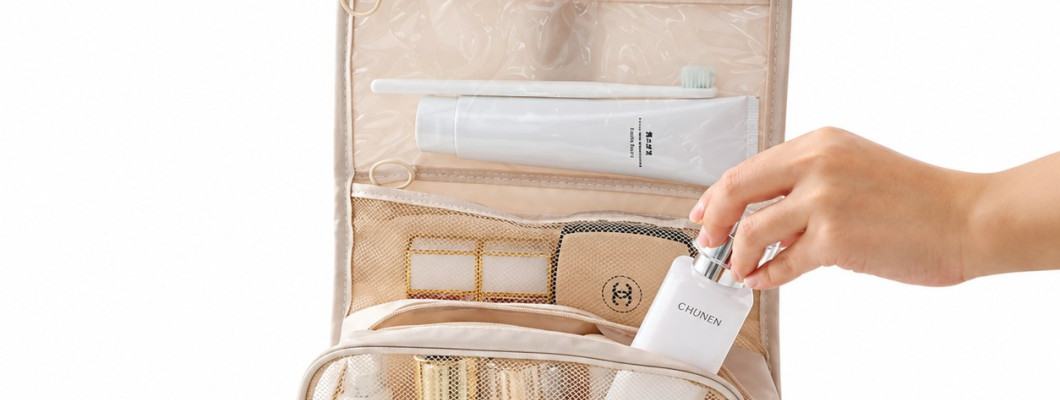
To choose a hanging toiletry bag, compare your essentials with its closed size, then check the space it needs when fully opened. Arrange products around your routine, use a suitable and stable hanging point, and provide separate containment for bottles that could leak.
The practical advantage is access to your essentials without spreading everything across a bathroom counter. However, a hook alone does not guarantee a convenient setup. Bottle shape, folding space, hanging height and the way you return items all matter. This guide explains how to assess those details before buying and how to use the organiser comfortably during your stay.
How does a hanging toiletry bag differ from a regular pouch?
A regular pouch collects products in a space you carry and place on a surface. A hanging design opens into accessible sections that can remain suspended from a suitable point. The better choice depends on your routine and accommodation.
If you prefer taking out a small group and using it on a counter, a simple pouch may meet your needs. A hanging organiser may be useful when you want several categories visible without emptying them.
Think about the rooms you usually stay in. Consider available counter space, possible hanging points and how often you change accommodation. These details are more useful than choosing from an attractive display photograph alone.
Start with your routine rather than your entire collection
Gather the products you use during an ordinary day, then decide which are relevant to the trip. Your selection may include toiletries, skincare, makeup and small grooming accessories. It does not need to reproduce your whole bathroom cabinet.
Consider morning preparation, going out and evening care separately. Some items serve several parts of the day, while others may have no role in the current itinerary.
Keep product instructions and storage requirements in mind. An organiser changes where items are kept together; it does not change how a particular product should be stored or transported.
Separate essentials from optional additions
Pack around the items you need to complete your usual routine first. Then consider additions connected to confirmed activities. This makes it easier to decide what to remove if the layout becomes crowded.
Do not treat every remaining gap as space that must be filled. Some flexibility makes returning products easier. A perfectly tight arrangement created at home may be frustrating to repeat when you are preparing to leave a hotel.
Compare both the closed and open dimensions
The closed measurements help you assess the footprint inside your luggage. The open measurements help you understand the extended shape during use. Both matter because convenient packing does not automatically mean convenient hanging.
Check the place reserved for the organiser among your other luggage groups. Then imagine opening it near a counter, shelf or basin. Nearby objects may restrict access even when the hanging point itself is suitable.
Two dimensions do not establish total capacity. Filled thickness and internal pocket measurements also affect fit. If carrying one particular bottle is essential, assess the relevant compartment rather than relying only on the overall dimensions.
Measure containers with their closures in place
Consider each container as it will travel, including its lid, pump and projecting parts. Its practical size may differ from the size of the bottle body.
Lay the selected products out before inserting them. Notice wide containers and pieces that may meet when the organiser folds. Two items can fit their individual pockets yet create an awkward overlap when the sides come together.
The K&M hanging makeup and toiletry organiser
The organiser offered by K&M Shopping has a folding design, a top hanging hook, a carry handle and transparent and mesh sections, including zippered compartments. Review its photographs and options on the hanging makeup and creams travel bag product page.
| Detail | Available information | What to assess |
|---|---|---|
| Closed dimensions | Approximately 23.5 × 20 cm | The footprint reserved inside your luggage |
| Open dimensions | Approximately 23.5 × 40.5 cm | The space needed for the extended organiser |
| Internal layout | Transparent and mesh sections with zippered pockets | The shape and size of your individual products |
| Hanging and carrying | Top hook and carry handle | A suitable, stable location for use |
| Listed colours | Sky blue, pink, beige, grey and navy blue | The option available when ordering |
The exact material composition, water resistance, litre capacity and maximum load are not specified or confirmed. Request further measurements when the fit of a particular container is central to your decision.
Arrange compartments around the order of use
Sorting by product type can work, but grouping items used together may be more convenient in temporary accommodation. Keep morning essentials in related areas and give evening products a recognisable location.
This does not require placing an entire routine in one pocket. Related products can occupy neighbouring sections according to their size. The aim is to avoid searching unrelated areas for each step.
Give shared-use items a permanent place. Moving one product between morning and evening groups makes it harder to remember where it belongs and whether it has returned before departure.
Use visible sections for easily overlooked items
A section that reveals its contents can be useful for something small you want to check at a glance. Choose according to your own habits rather than arranging products purely by appearance.
For pieces that could escape or become mixed, use an appropriately sized closable section. Check the relationship between the item and the pocket instead of assuming every compartment suits every small accessory.
Practise folding before packing your suitcase
Begin with the essential group and add optional items gradually. After a meaningful change, fold and close the organiser gently. This reveals crowding that may be difficult to notice while all sections lie open.
- Prepare the selected essentials and check container closures.
- Distribute items by size and intended use.
- Check projecting parts and items that meet during folding.
- Close compartment zippers without catching fabric or tools.
- Fold the bag and secure it without forcing the contents together.
- Open it again, retrieve an essential product and return it.
If every closure requires rebuilding the arrangement, reduce the contents or change their positions. A practical layout should be easy to repeat away from home.
Organisation does not replace leak precautions
The bag separates products but does not guarantee containment of leaking creams or liquids. Check lids, follow container instructions and use suitable sealed inner bags for products that could leak.
Pay attention to pumps and closures with a particular locking position. A bottle that behaves well while standing on a shelf may be carried differently inside luggage.
Also inspect neighbouring contents. Crowding can place pressure on a container when the organiser folds. If a leak occurs, remove affected items and deal with them appropriately. Clean and dry the organiser before repacking rather than closing it around the problem.
Inspect the hanging location before unpacking products
On arrival, look for a suitable, stable point you can reach comfortably. Do not assume that every handle, projection or fitting is intended to support a hanging organiser.
Check the space below and around it. The sections should open without resting awkwardly on the basin edge or pressing against nearby objects. You should also be able to operate the pockets without repeatedly pulling the whole bag towards you.
Choose a position away from direct splashes and suitable for the products themselves. If the location is inconvenient, use an appropriate clean, dry surface instead.
Check access from your normal position
A comfortable height for one person may be awkward for another. Choose a position where you can see and retrieve frequently used products without repeatedly reaching high or bending around furniture.
In a shared bathroom, consider door movement and access to the basin. A stable hanging point can still obstruct another person. A less crowded position may be more practical than the point closest to the tap.
What if there is nowhere suitable to hang it?
Keep an alternative routine rather than improvising an unsuitable attachment. Open the organiser on a clean, dry and appropriate surface, take out the required group and return it afterwards.
If counter space is limited, you do not need to leave every compartment displayed throughout the stay. Store the bag appropriately between uses while keeping the same internal arrangement.
Avoid adding hooks or adhesive fittings to accommodation without permission and confirmation of suitability. The compartments still provide useful organisation even when the room does not support hanging use.
A short stay: prioritise simple retrieval and return
For a short trip, reducing the contents may matter more than creating additional categories. Select what covers the planned stay and activities, then identify the products needed each morning.
Take out only the current group. Emptying everything onto a surface can remove the benefit of the compartments and create another collection task whenever you move.
Keep departure-morning items on a clear final check. Do not consider the bag complete the previous evening if a brush or bottle remains in use. Return that last group, check closures and then fold the organiser.
Moving between several places to stay
When accommodation changes frequently, consistent product locations become useful. Keep the basic internal arrangement even when the available surface or hanging position differs from room to room.
Before leaving, check where products were actually used: the basin, dressing area, shelf or another temporary location. Compare what you collect with your selected group rather than assuming full-looking pockets mean everything is present.
At the next destination, inspect the setup again. A successful hanging position in one hotel does not establish that a different fitting or height will work equally well.
Sharing an organiser without mixing belongings
First distinguish genuinely shared products from personal ones. Give each group a clear location rather than combining containers simply because they look similar.
Dividing by person may suit independent routines. Dividing by task may work for a small, clearly understood selection. Choose the method that reduces repeated questions about where something belongs.
Agree on returns as well. If someone takes a product elsewhere, the other user should know it is temporarily outside the bag. Each person should review their belongings before departure instead of leaving the whole check to whoever carries the organiser.
Brushes and small tools need a different fit check
Check a tool’s full length and shape. A brush may enter a pocket while its head becomes compressed during folding. Review the closed arrangement and use its suitable cover or storage protection where needed.
Do not put damp or used tools among ready-to-store contents simply because the session has ended. Clean and dry them according to their instructions before packing.
Position small pieces so they can be retrieved without removing several products above them. If an item is repeatedly overlooked, improve its location or include it in your checklist rather than repeatedly replacing it.
Review the layout after changing one bottle
A replacement cream may come in a wider container, or a new bottle may have a pump. Even with the same product count, the changed shape can affect pocket closure and folding.
Start with the changed item and inspect what sits beside it and opposite it when folded. One adjustment or removing an unnecessary product may be enough.
Repeat the retrieval check afterwards. You should be able to take the product out and return it without rearranging several others. Ask for relevant internal dimensions if fit remains uncertain.
Clean and reset the bag after returning home
Empty the organiser after the trip and inspect its sections before storage. Return products to their normal places and review containers according to their own information rather than leaving everything packed until the next journey.
Use gentle spot cleaning and leave the bag open to dry. Machine washing and full immersion are not confirmed, so consult the care label before choosing another method.
Make a short note of anything you needed but lacked, and anything carried without use. That record can improve the next selection without adding products for vague possibilities.
Common mistakes when choosing a hanging toiletry bag
Judging space only while the bag is open can hide a folding problem. Similarly, a transparent pocket should not be treated as proof of liquid containment.
Another mistake is using an unsuitable hanging point because the counter is crowded. Reconsider the setup instead of relying on a fitting that does not suit the purpose.
Finally, the organiser itself does not establish whether every container is permitted in aircraft cabin baggage. Before flying, check the requirements relevant to your journey rather than relying on the bag’s name or appearance.
A checklist before closing your main luggage
- The selected products match the trip length and my actual routine.
- I checked containers with lids and projecting parts included.
- The organiser folds without pressing the contents together.
- Leak-prone products are closed and appropriately contained.
- Tools are ready for storage rather than damp or awaiting cleaning.
- I have an alternative routine if hanging is unsuitable.
- I know which items remain outside until departure morning.
Address a specific problem before adding more equipment. A clear group and an easy return routine are often more useful than immediately choosing a larger bag.
Frequently asked questions about hanging travel toiletry bags
Is a hanging bag better than a regular makeup pouch?
It depends on your routine and accommodation. Hanging access can help when a suitable point is available and you want several sections accessible. A regular pouch may be sufficient for a small group used on a counter.
Do the closed dimensions show how many bottles will fit?
No. Bottle shape, thickness and internal pocket dimensions affect capacity. Use the overall measurements for an initial comparison, then check the relevant section when a particular container must fit comfortably.
Does this organiser include a hook and carry handle?
Yes, both are listed features. Choose a suitable, stable hanging location rather than assuming every rail, hanger or fitting in the room is appropriate for the filled bag.
Will the bag prevent creams and liquids from leaking?
Leak prevention is not guaranteed. Secure container closures, follow their instructions and provide suitable additional containment. Water resistance of the organiser itself is also not confirmed in the available information.
Can it hold full-size bottles?
That depends on the bottle, the relevant compartment and the folded arrangement. The external width is not all usable pocket space. Request further measurements if a specific bottle determines your choice.
What should I do without a suitable hotel hook?
Use an appropriate clean, dry surface and return products after use. Hanging is optional for benefiting from the compartments. Do not rely on an unsuitable point simply to keep the organiser displayed.
Can I leave it where it receives direct water splashes?
Choose a location away from direct splashing and follow the storage requirements of the products inside. Transparent and mesh sections do not establish suitability for continuous water exposure or use under a shower.
Can the organiser be machine washed?
Machine washing is not confirmed. Use gentle spot cleaning and complete drying, and consult the supplied care instructions before immersion or a wash cycle that may not suit its different components.
Is the organiser only for makeup?
It can organise compatible toiletries, personal-care essentials and small accessories. Choose contents according to their size and purpose, while separately containing anything that requires additional protection or handling.
When should I rearrange the pockets?
Review them when a container changes size, your routine changes or returning and closing become difficult. Keep the parts that work and adjust the affected area rather than rebuilding the entire arrangement unnecessarily.
Use access and repacking as your decision criteria
Start with necessary products, compare the open and closed footprint, and practise folding and retrieval before travelling. At your destination, adapt to the available room rather than forcing the same setup everywhere.
Explore travel and organisation essentials at K&M Shopping and compare the options with your routine. A useful organiser keeps selected products in understandable sections and makes them straightforward to use, return and collect when it is time to move on.
Leave a Comment