
How to Carry Coffee with a Rolling Suitcase: A Practical Luggage Cup Holder Guide
How to Carry Coffee with a Rolling Suitcase: A Practical Luggage Cup Holder Guide
You have a rolling suitcase in one hand and a drink in the other. Then you need to check your departure information, retrieve a document, or move your personal bag. None of these tasks is particularly difficult on its own, but managing them together can become awkward.
A luggage cup holder may help with part of that routine. Whether it is useful depends on your suitcase, the container you carry, and the stages of your journey. Choosing an accessory is only the beginning; knowing when to use it and when to put it away matters just as much.
This guide explains how to assess your needs, check compatibility, rehearse the arrangement before traveling, and plan the transitions that require a different setup.
Quick Answer
Choose a luggage cup holder by checking its attachment requirements against your actual suitcase handle and the containers you intend to carry. Try the arrangement before the trip, keep your essential belongings organized separately, and plan how you will empty and store the accessory when your handling needs change. Do not treat it as a guarantee against spills.
Contents
Identify the awkward part of your journey.
Consider which suitcase stays with you.
Understand what the accessory does.
Check the product information.
Compare your handle and drink containers.
Practice setup and removal at home.
Plan around different travel stages.
Organize documents and personal belongings.
Adapt the routine to different trips.
Avoid common mistakes.
Use the checklist and FAQs.
Follow the step-by-step starting plan.
Identify the Task You Want to Simplify
Think about a recent journey and identify the moment when your hands felt overloaded. Were you pulling luggage while holding coffee, searching inside a crowded bag, or carrying purchases that could have been packed differently?
These situations are related, but one accessory will not necessarily solve all of them. If your documents are difficult to locate, improving their storage may help more than adding another pocket.
Describe the task clearly. “I want a suitable place for my drink during a particular walk through the terminal” is more useful than “I want easier travel.”
That statement also gives you a way to assess the purchase afterward. You can judge whether it helped with the intended task instead of expecting it to improve every part of the trip.
Consider Which Suitcase Remains with You
Before choosing an accessory, identify the luggage you will actually handle during each stage. The suitcase you take from home may not be the one that stays with you after baggage drop.
If you intend to attach the holder to a checked suitcase, consider how long you will use it before handing over that bag. A short period of usefulness may still matter to you, but it should be a deliberate choice.
Also review what remains after that point: a cabin bag, a personal bag, or both. Do not assume that a product suited to one handle will transfer to another.
Plan with the actual bags for this journey rather than a general picture of how you usually travel.
Think in Stages, Not One Continuous Walk
Travel involves repeated changes of task. You may walk, queue, sit, retrieve belongings, lift a bag, and board a vehicle within a relatively short period.
For each stage, ask what you need your hands to do. An arrangement that is convenient while walking might need to be dismantled before the next activity.
This does not require a complicated itinerary. A few notes can reveal the important transitions: before baggage handover, before lifting luggage, and before settling into your seat.
The goal is to avoid discovering the next task while still managing the previous one. Knowing where your drink and accessory will go makes those transitions easier to prepare for.
What a Luggage Cup Holder Adds
A luggage-mounted organizer gives selected items a designated place near the handle. Its usefulness depends on whether that location fits the way you move and handle your bags.
It is worth distinguishing this function from other needs. A place for a drink is not automatically a secure location for valuables. An accessible pocket does not replace a deliberate document-storage routine.
Likewise, an accessory does not turn a suitcase into a table or make every movement appropriate with drinks attached.
Consider it for a defined part of your trip. There is no requirement to leave it installed throughout the journey for the purchase to be worthwhile.
The K&M Shopping Option
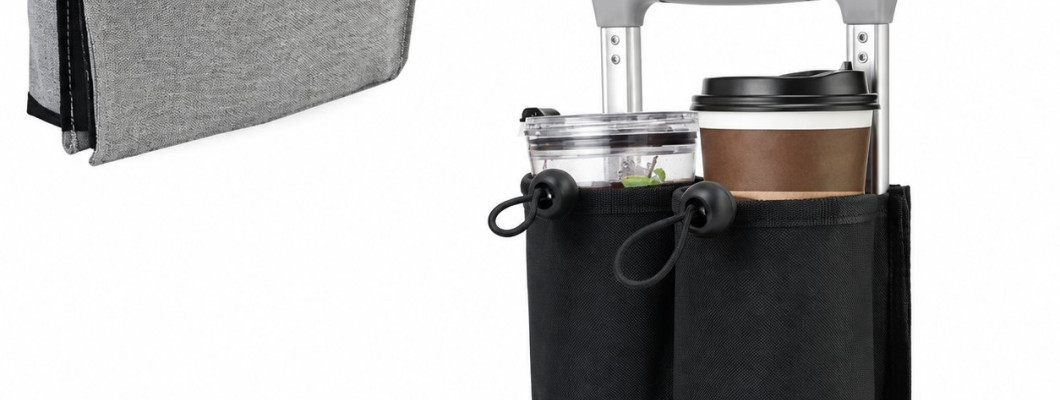
The Travel Suitcase Cup Holder from K&M Shopping is a foldable fabric organizer for a compatible dual-rod telescopic handle. It has two drink spaces, adjustable upper drawstrings, and a side pocket.
The package contains one holder. Grey and black are listed, subject to the options available.
Product details:
https://k-m.store/shop/en/kn13-travel-bag-cup-stand
Exact dimensions, fabric composition, and a numerical load rating are not confirmed. Do not infer them from photographs. If a missing measurement determines whether the product suits your luggage or containers, ask for clarification before ordering.
Photographs illustrate the arrangement; the suitcase, drinks, and phone shown should not be assumed to be included.
Check Your Actual Handle
Take out the suitcase you intend to use and extend its handle. Look at its construction, the spacing of its rods, and the area where the accessory would sit.
Two suitcases can look similar overall while having different handle details. A familiar brand or approximate bag size is not enough to establish compatibility.
Record the measurements relevant to the attachment and take a clear photograph if you need to discuss them with the seller. Keep confirmed information separate from assumptions.
Also consider other belongings already occupying the handle area. If your personal bag normally rests there, work out whether the intended arrangements are compatible rather than assuming everything can share the same space.
Ask Useful Questions Before Ordering
Specific questions are easier to answer than “Will it fit my suitcase?” Describe the handle and identify the detail you need confirmed.
For example, ask which handle measurements are required to assess the attachment. If the listing does not provide a measurement range, do not turn that absence into a universal-fit claim.
Ask about your intended container as well. An adjustable feature has practical limits, and its presence does not establish compatibility with every shape.
If an essential detail remains unresolved, acknowledge that uncertainty in your buying decision. It is better to understand a limitation before a trip than to discover it when there is little time to reorganize.
Choose the Containers You Really Use
Start with a familiar bottle or reusable cup, rather than an imagined collection of drinks you might purchase.
Notice its shape, base, handle, and closure. A capacity label tells you how much it holds, not whether its exterior works with a particular organizer.
If you expect to carry two different containers, assess them individually. One suitable bottle does not establish that another cup will behave the same way.
Consider what happens when you remove the drink, too. You need a practical plan for handling it during the next task. The accessory should fit into that plan rather than becoming the only place you can imagine putting the container.
Practice at Home Before the Trip
Use a level area and begin with the accessory empty. Follow the product instructions, then try suitable empty containers before considering filled ones.
The listed method is to extend the handle, fit the organizer around its two rods, check that it sits level without slipping, and adjust the drawstrings around securely closed containers without pressing on their lids.
Practice removal as well as installation. Notice whether you can complete both without struggling or moving numerous other belongings.
A home rehearsal is for identifying practical incompatibilities. It does not establish performance under every travel condition or justify testing beyond the product’s stated purpose.
Rehearse the Next Task
Once you understand setup, think about what you usually do immediately afterward. You might open a bag pocket, take a seat, or prepare to lift the suitcase.
Rehearse those transitions with empty containers and without rushing. Look for conflicts between the accessory and the tasks your luggage must perform.
If you repeatedly need to remove it, that does not automatically make it useless. It may simply belong in a shorter, clearly defined part of the journey.
Decide where it will go when removed. A storage location that requires opening the whole suitcase may be inconvenient in a busy setting, so plan an appropriate accessible place before departure.
Choose When to Add a Drink
Sometimes the simplest improvement is timing. If you are about to perform several tasks involving your luggage, waiting before buying a drink may be more practical.
Look at what remains before your next planned pause. You can then decide whether carrying the drink now fits the immediate sequence.
This is an organizational choice, not a rule that applies to every airport or station. Different journeys involve different layouts and procedures.
If traveling with someone else, coordinate the purchase. Decide who manages which belongings instead of assuming one person can hold every bag while the other collects several drinks.
Keep Documents on Their Own Routine
Choose a consistent place for important travel documents and return them there after use. A familiar routine is easier to maintain than moving them among several convenient pockets.
Before walking away from a counter or waiting area, confirm that the documents you handled have returned to their intended location.
Convenience and security are different considerations. Do not assume an open or accessible compartment offers protection against loss, theft, or damage.
Use any temporary storage deliberately and keep your belongings under your supervision. If the accessory makes your document routine less clear, simplify that routine rather than adding more places to remember.
Plan When to Empty the Holder
The product guidance calls for removing drinks before stairs, escalators, and handing over the suitcase. Plan those changes before reaching the point where you need to act.
More broadly, pause whenever the next task requires a different way of handling the bag. Do not try to preserve one arrangement through every transition.
Place each item somewhere appropriate, then deal with the luggage. A short stop is often easier to manage than several competing actions performed at once.
Travel arrangements can change, so keep the process straightforward enough to repeat even when the journey does not follow your original plan.
Check Instructions for Your Actual Journey
A drink holder does not change airport screening, baggage, or liquid requirements. The way an item is attached to a bag does not create an exemption.
Review the official guidance relevant to your departure point, transport provider, and any connections. If you have a particular container or special circumstance, look for information addressing that situation.
Avoid relying on another traveler’s experience from a different route as if it were a complete instruction for yours.
Keep the arrangement easy to empty and reorganize when staff instructions require it. A clear plan for the contents matters more than keeping the accessory in use continuously.
Scenario One: Traveling Alone for Work
A solo traveler may already be managing a suitcase, personal bag, and work-related belongings. Start by deciding where documents and devices belong before introducing a drink.
Choose the stage where the accessory would address a real inconvenience. Outside that stage, put it away if doing so makes handling the bags simpler.
After the trip, review the result. Did it help with the specific moment you identified, or did a crowded personal bag remain the main source of difficulty?
Use that answer to improve the next journey. An accessory should be evaluated by the task it performs, not by the number of trips on which you carry it.
Scenario Two: Traveling with a Companion
Agree on who handles the suitcase and when each person takes responsibility for their own drink and belongings.
Do not automatically assign every small item to the person with the organizer. Extra storage does not remove the practical limits on how many tasks one person can manage.
At a transition, coordinate before moving. One person can retrieve their belongings while the other prepares the luggage, rather than both reaching into the same area simultaneously.
Keep the arrangement understandable. Each traveler should know where their items are and what happens when the accessory is emptied.
Scenario Three: Waiting Before Boarding
A long wait can make it tempting to spread belongings across several locations. Then boarding begins, and everything needs gathering at once.
Use part of the waiting period to prepare for the next stage. Review what needs packing, what must remain accessible, and how you will handle any remaining drink according to applicable instructions.
Avoid saving every small task for the announcement. Retrieving documents, rearranging a bag, and storing an accessory are easier when they do not all compete for attention.
The purpose is not to create a rigid schedule. It is to finish manageable tasks while there is time to do them calmly.
Common Mistakes to Avoid
Assuming compatibility from a photograph
Use images to understand the design, then confirm the information that affects your particular setup.
Filling every available pocket
Additional space does not need additional belongings. Keep only items with a clear purpose.
Expecting complete spill prevention
A holder cannot remove every risk associated with a container, its closure, or how luggage is handled.
Practicing installation but not removal
Knowing how to put the accessory away is essential when the next stage requires a different arrangement.
Leaving preparation until departure
A rushed first trial makes it harder to identify and resolve fit problems before they matter.
Care and Storage After the Trip
The listing does not confirm machine-washing instructions. It recommends spot cleaning with a damp cloth and allowing the holder to dry before folding; do not assume soaking or tumble drying is appropriate.
Review its condition before storing it. If something appears damaged or no longer functions as intended, address that before another journey.
Give the accessory a predictable place among your travel supplies. Keeping it in a different bag each time can make it difficult to find when packing.
Also note whether you used it. If it stayed packed throughout the trip, consider whether your next itinerary creates a genuine need for it.
A Pre-Trip Review
Ask what has changed since the previous journey: a different suitcase, another drink container, a new companion, or a different baggage plan.
Recheck the relevant details rather than treating an earlier successful use as permanent proof of suitability.
For other travel accessories, explore K&M Shopping:
https://k-m.store/
Browse with a defined task in mind. Useful packing is about selecting items that support the journey, not collecting every accessory that might conceivably help.
Before-Departure Checklist
Identify the stage where the holder will be useful.
Check the actual suitcase and handle.
Clarify important missing compatibility information.
Practice installation and removal before traveling.
Assess the intended containers individually.
Give important documents a consistent location.
Plan when to empty and store the accessory.
Review official instructions for the journey.
Keep expectations about performance realistic.
Quick Answers
Best starting point: Your actual luggage and intended container.
Most useful preparation: A calm rehearsal before departure.
What to avoid assuming: Universal fit, unspecified capacity, or guaranteed spill prevention.
When to put it away: Whenever the next task or relevant instructions require a different arrangement.
How to judge value: Whether it improves a recurring part of your own travel routine.
Frequently Asked Questions
Does this type of holder fit every suitcase?
No. Suitcase handles differ, and the product’s attachment requirements must match your luggage. Check the actual configuration and ask about missing compatibility information before buying.
Do adjustable drawstrings mean every cup will fit?
No. Adjustment does not establish unlimited compatibility. Container shape and dimensions still matter. Evaluate the cup or bottle you intend to use rather than assuming a similar-looking example proves fit.
Is it suitable for an open drink?
Use securely closed containers as directed. A retaining feature is not a substitute for a lid, and the holder should not be treated as protection against liquid escaping from an open cup.
Are the suitcase and cups included?
The listing specifies one holder. Props used to demonstrate an arrangement should not be considered included unless the offer explicitly identifies them as package contents.
Can I use the pocket for valuables?
Do not treat it as a secure-storage system. Keep important belongings supervised and follow a consistent storage routine. Accessibility alone does not establish protection against loss or theft.
Should it remain loaded when I hand over my suitcase?
No. Remove drinks and personal belongings, then prepare the bag according to the transport provider’s instructions. Store the accessory appropriately when its use has finished.
Can I rely on it to prevent coffee spills?
No accessory should be interpreted as a complete guarantee. The container, closure, movement, and situation all matter. Keep expectations within the product’s stated purpose.
Can I machine-wash it after traveling?
Verified machine-washing instructions are not provided. Follow the stated care guidance and ask for clarification before using a cleaning method that has not been confirmed.
What if I use a different suitcase next time?
Repeat the compatibility check. A successful arrangement with one bag does not prove the same result with another handle design or luggage configuration.
How do I decide whether I need one?
Identify a recurring travel task it would simplify. If you cannot name that task, first review how your existing belongings are packed and handled. A better routine may address the difficulty without another accessory.
Step-by-Step Starting Plan
Step 1: Identify the specific travel task.
Step 2: Check the suitcase you will actually use.
Step 3: Collect relevant compatibility information.
Step 4: Assess your intended drink containers.
Step 5: Practice setup and removal at home.
Step 6: Plan document storage and transitions.
Step 7: Use the accessory only where appropriate.
Step 8: Clean, inspect, and store it after the trip.
Conclusion
A luggage cup holder is most useful when it has a clear role in a well-planned journey. Check compatibility, practice beforehand, and know where everything goes when the arrangement needs to change.
Choose around your real travel habits, and keep the setup simple enough to manage without rushing.
Quick Summary
Start with a specific need.
Verify fit rather than guessing from images.
Prepare before reaching the terminal.
Keep documents organized separately.
Plan the moments when the holder must be emptied.
Follow the instructions relevant to your journey.
Review usefulness after each trip.
Read Also
For another practical part of preparing your luggage before departure, read the guide to weighing a suitcase at home:
https://k-m.store/shop/en/blog/how-to-weigh-luggage-at-home
Leave a Comment