
How to Organise a Travel Makeup Bag: Choosing the Right Case and Packing Personal-Care Essentials
How to Organise a Travel Makeup Bag: Choosing the Right Case and Packing Personal-Care Essentials
A makeup bag can look organised when first packed and become difficult to use after one morning. A small item disappears behind a bottle, a used brush returns beside clean tools, or an extra product makes the zipper difficult to close.
The solution is not always a larger bag. Sometimes the contents need clearer categories, fewer duplicates or a different arrangement. The right case should support the routine you actually follow, with enough room to remove and replace items without disturbing everything else.
This guide explains how to choose a cosmetic organiser, assess its compartments and prepare makeup, skincare, liquids and tools for travel. It also covers the confirmed features of the K&M Shopping KN14 bag and the details you should verify before relying on them.
Quick Answer: How Should You Pack a Travel Makeup Bag?
Start with the products your trip requires, then separate makeup, skincare, brushes and small accessories. Check each container’s closure, place liquids in an additional suitable sealed pouch and keep clean tools apart from used ones.
Measure your largest item and tallest bottle before choosing a case. Test both closing the bag and accessing its contents. Compartments help organise belongings, but they do not establish waterproof construction, leak containment or protection against breakage.
A practical arrangement should work repeatedly during the trip, not only look tidy before departure.
Contents
Choose products around your actual routine.
Separate organisation from protection.
Check dimensions and compartments.
Review the KN14 cosmetic bag.
Arrange makeup, skincare and liquids.
Give brushes and accessories clear places.
Test the packed bag.
Adapt the setup for different trips.
Review cleaning and maintenance.
Read ten frequently asked questions.
Start with a Typical Day, Not Your Entire Collection
Set out the products you would use during a day similar to those planned for the trip. Consider the morning routine, evening care and any specific event.
For each item, identify its purpose and likely use. This helps distinguish an essential from something added only because there is space.
There is no need to minimise at the expense of an important requirement. The aim is a deliberate selection rather than carrying every alternative.
An empty compartment is not an instruction to add another product. Some spare room can make it easier to return belongings after use and close the bag without pressure.
Make a Short List by Function
Divide the selection into useful categories: skincare, makeup, brushes and tools, and small accessories. The groups do not need equal numbers of items.
Beside each product, consider its container size, condition and closure. A loose cap or pump that cannot be secured is a packing issue even when the bottle fits comfortably.
Identify essential items clearly so that last-minute packing does not depend entirely on memory. At the same time, avoid using the checklist to justify several backups for every product.
A useful list tells you what belongs in the bag and makes missing or empty items easier to notice.
Understand What Compartments Can and Cannot Do
Internal divisions give products designated places and can reduce unnecessary movement. They do not necessarily create sealed sections.
If a container leaks, do not assume that a divider will prevent the contents from reaching another part of the bag. Separate liquid protection remains important.
Likewise, a portable cosmetic case is not automatically a rigid protective box. Glass containers and fragile makeup items still need an arrangement appropriate to their requirements.
Think of organisation, closure security and physical protection as separate checks. A bag may help with the first without providing all the others.
Measure the Products That Determine Fit
Begin with the tallest container, widest palette and longest tool you intend to carry. Include caps, pumps and any protective covers in those measurements.
Then ask for the bag’s external and usable internal dimensions if they are not published. A photograph may show the general design without establishing whether your particular items will fit.
If a product needs to remain upright according to its instructions, confirm that the available height allows the bag to close in that position.
Do not translate “large capacity” into a guaranteed number of bottles. Practical capacity depends on their shapes, the compartment layout and the space needed for access.
Assess the Actual Compartment Layout
Open the bag and identify the main storage area and the divisions that are actually present. Avoid planning around an assumed pocket count.
Place the larger suitable items first, then decide where smaller frequently used products should go. A product needed every morning should not be hidden behind something used only once during the trip.
Leave enough room to remove and replace items. Filling every section to its limit may create an arrangement that is difficult to maintain.
The useful question is not simply whether everything fits at once. It is whether the layout remains workable after several openings, uses and repacking sessions.
What the K&M Shopping KN14 Bag Offers
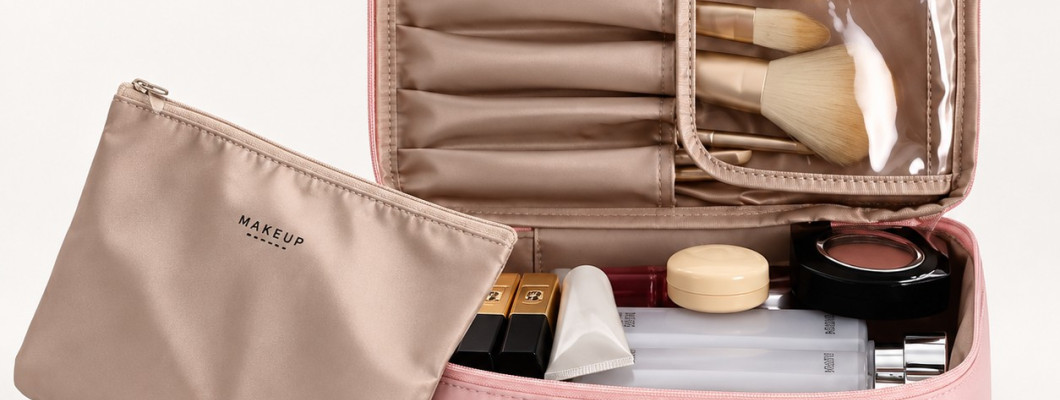
The KN14 cosmetic bag is described as a lightweight, portable organiser for makeup, creams, toiletries, small perfumes, brushes and accessories that fit its available space.
The listing confirms internal compartments and use at home, at work and during travel. Currently listed colours are green, pink, grey and black, subject to the available options when ordering.
Review the product here:
Dimensions, exact material and a numerical capacity are not provided. Water resistance, hanging capability, machine washing and a double-zipper arrangement are not confirmed. Choose based on verified organisation features and clarify anything essential before purchasing.
Arrange Makeup Around Frequency of Use
Keep the everyday selection accessible. Products reserved for a particular occasion can have a separate suitable position if the available layout allows it.
Check that lids and cases close properly before packing. Do not use surrounding products to hold a faulty lid shut or depend on a tight fit to prevent movement.
Avoid placing a wide palette where it must bend the bag or press against smaller containers. If it does not fit appropriately, choose another packing arrangement.
Grouping by use can be more helpful than grouping only by appearance. The objective is to find the next item without repeatedly emptying the main compartment.
Keep Skincare Products Identifiable
Use suitable containers and retain the information needed to identify and use each product correctly. Follow the product’s own storage and care instructions.
If you use an appropriate alternative container, make sure the contents remain clearly identifiable. Several similar unlabelled bottles can create confusion during a rushed morning.
Do not combine different products or leftover contents simply to reduce the number of containers. Packing should not change a formulation or introduce an unsuitable storage method.
When a bottle is too large, consider a suitable alternative rather than assuming that the cosmetic bag can accommodate it if other items are squeezed around it.
Secure Liquids Before Adding Secondary Protection
Check caps, lids and pump closures individually. Remove external residue appropriately and confirm that any built-in locking feature is engaged.
The KN14 listing recommends an additional sealed pouch for liquids because leak protection is not confirmed for the cosmetic bag itself. Choose a suitable pouch that closes without being overfilled.
This additional layer does not make a damaged container suitable for travel. If a cap does not hold or a bottle is already leaking, resolve the container problem first.
Do not assume that a fabric compartment or a closed zipper will contain spilled product. Organisation and liquid containment are different functions.
Give Clean Brushes Their Own Space
Arrange brushes so that containers do not press against or bend their heads. If you use a suitable brush cover or case, include its size when checking the bag’s capacity.
Keep clean tools separate from those carrying product residue. After use, set aside the appropriate tools for care rather than returning everything automatically to the clean group.
Follow the care instructions for each tool, and avoid putting damp items away among other products.
For a broader guide to choosing and using makeup brushes, read:
https://k-m.store/shop/en/blog/makeup-brushes-beginners-guide
The cosmetic bag should make tools easier to find without becoming a substitute for their cleaning and storage requirements.
Contain Small Accessories Without Adding Too Many Layers
Hair ties and other small belongings can disappear beneath bottles. A suitable compartment or small closed pouch can keep a defined group together.
Use the appropriate protective cover for any tool with a sharp or exposed end. Do not assume a divider prevents it from contacting neighbouring contents.
However, avoid placing every small item inside another separate case. Too many layers can make access slower and consume useful space.
Choose a grouping that you can explain easily. If you need to open several containers to retrieve one frequently used item, simplify the arrangement.
Test Closing and Reopening
Once packed, close the bag gently. If the zipper meets resistance, stop and inspect the position of bottles, lids and longer tools.
Do not press down heavily with one hand while forcing the zipper with the other. Remove or reposition the obstruction, or reduce the contents.
Then reopen the bag and retrieve the products needed for a normal routine. Return each item to its place.
This practical test reveals problems a static arrangement can hide. A bag that closes successfully may still be inconvenient if a small essential is trapped behind the largest bottle.
Check Its Position Inside Your Luggage
A cosmetic bag that fits comfortably on a table can be compressed when placed among tightly packed clothing or footwear.
Choose a location that does not put unsuitable pressure on the containers. Do not rely on the outer bag to protect fragile contents from everything around it.
Review the suitcase closure after adding the cosmetic bag. If the luggage needs force to shut, change the overall arrangement rather than expecting the toiletries to absorb the pressure.
Also consider access at the destination. Placing the bag where it can be removed without disturbing every clothing group can make arrival more straightforward.
Short-Trip Example: A Defined Routine
For a short stay, select the products required for the activities you have actually planned. Include any specific occasion without automatically packing several versions of the same routine.
Give the regular morning and evening items clear positions. Keep liquids appropriately separated and make room for brushes or tools to be returned after use.
Try the packed arrangement before leaving. Notice which items require unnecessary searching or rearrangement.
If the case feels crowded, review optional additions first. The aim is not the smallest possible bag, but a complete and usable selection that does not compete with itself for space.
Workday Example: A Smaller Everyday Selection
A bag carried between home and work may need a different collection from a holiday case. Identify what you genuinely use away from home.
If an item belongs to both routines, give it a consistent return place. Otherwise, it can be absent from the bag while the overall collection still appears complete.
At the end of the day, check what needs cleaning, replenishing or replacing. Remove empty containers rather than allowing them to occupy their usual sections.
A useful everyday arrangement makes missing items visible and keeps the carrying routine simple. It should not require moving an entire travel collection back and forth unnecessarily.
Hotel Example: Limited Counter Space
Before unpacking, choose a suitable dry surface away from direct splashes and edges. Water resistance is not confirmed for this bag.
If space is limited, remove only the group needed for the current routine. Keep the remaining contents organised rather than spreading everything across the basin area.
After use, check that containers are closed and their exteriors are suitable for returning to the bag. Keep used tools separate until they receive appropriate care.
Do not hang the bag from a zipper or another part not intended for that purpose. Hanging capability is not confirmed for this model.
Plan a Clear Departure Check
Look beyond the bag itself before leaving. Check the mirror area, bathroom shelf and any separate place where tools or products were used.
Close containers after use and review their condition before repacking. A full-looking bag does not prove that every essential is present.
Compare the contents with your original list, then check the closure and luggage position again. Purchases made during the trip may change the arrangement.
Separate anything still needing attention rather than placing a damp or dirty tool among clean products because departure is approaching. Leave enough time for the checks your routine requires.
Clean According to the Bag’s Actual Instructions
Empty the bag and identify the affected area before choosing a cleaning method. Consult any supplied care information or ask the seller when necessary.
The exact material and washability are not stated. Do not assume that machine washing, soaking or a method used for another cosmetic case is appropriate.
The listing advises gentle cleaning of affected areas using a method suitable for the material. Allow the bag to dry fully after any permitted cleaning before returning products.
If a leak occurred, inspect the responsible container and neighbouring contents as well. Cleaning the bag alone does not prevent the same closure problem from happening again.
Review the Contents Periodically
Set aside time to remove the collection and review what is actually used. Identify empty containers, products needing attention and information on labels that requires checking.
Notice whether one replacement bottle has changed the available space. A wider base or taller pump may require a different position even when the product serves the same purpose.
Do not make every review an invitation to buy more organisers. Start by simplifying duplicates and restoring clear categories.
Then decide whether the current case still suits the selection. Sometimes the right adjustment is a better layout; sometimes the required contents genuinely need different dimensions.
Avoid Common Selection Mistakes
Do not rely on “large capacity” without checking measurements relevant to your products. Nor should you assume every internal section accommodates long brushes or tall containers.
Do not confuse a closed zipper with waterproof storage. Compartments and liquid protection are separate considerations.
Avoid overfilling, storing damp tools or assuming that the bag can hang from any convenient point.
Finally, do not infer a double zipper, a particular fabric or machine-wash suitability from similar-looking products. Confirm a feature when your intended use depends on it.
Before-You-Pack Checklist
Choose products that match the trip’s actual routine.
Identify the tallest container and largest item.
Confirm bag dimensions when fit is uncertain.
Check lids, caps and pump closures.
Separate liquids in an additional suitable sealed pouch.
Give clean brushes and used tools distinct places.
Contain small accessories without excessive layers.
Test opening, closing and replacing products.
Choose a luggage position without unsuitable pressure.
Follow confirmed care instructions.
Quick Answers
For size: Compare actual product dimensions, not capacity wording alone.
For liquids: Secure containers and use suitable additional separation.
For brushes: Preserve their shape and separate clean tools from used ones.
For zipper resistance: Reposition or reduce contents instead of pulling harder.
For easy access: Give frequently used products clear positions.
For cleaning: Confirm the appropriate method before soaking or machine washing.
Frequently Asked Questions
1. What does a multipurpose cosmetic bag do?
It groups makeup, personal-care products and suitable accessories for easier organisation and access. That does not automatically provide leak containment or protection against breakage.
2. What are the dimensions of the KN14 bag?
The product page does not publish dimensions. Request measurements before ordering if you need to fit a tall bottle, wide palette or a specific luggage compartment.
3. Does it have internal compartments?
Yes, internal organising compartments are described. Their exact number and individual measurements are not specified, so avoid planning around an assumed layout.
4. Is it waterproof or leak-proof?
Neither property is confirmed. Secure liquid containers and use an additional suitable sealed pouch rather than relying on the outer case alone.
5. Can it hold creams and small perfumes?
These are listed uses when the containers fit appropriately. This does not guarantee glass protection, secure upright placement or containment of a leaking bottle.
6. Can it be hung in a bathroom?
Hanging capability is not confirmed for this model. Do not suspend it from a zipper or an attachment not intended for that purpose.
7. Does it have double zippers?
The zipper configuration is not specified. Ask for confirmation before buying if a double-zipper arrangement is important to your use.
8. Can it be machine-washed?
Machine washing and soaking are unconfirmed. Follow supplied instructions or ask about suitable care, and clean affected areas gently using an appropriate method.
9. Which colours are available?
Green, pink, grey and black are currently listed. Check the available options when ordering because stock can change.
10. Is it suitable for everyday use?
Home and work organisation are listed uses alongside travel. Select contents for the actual daily routine rather than carrying a complete holiday collection unnecessarily.
Try One Complete Routine Before Travelling
Pack the chosen products, then use the bag once as you expect to at the destination. Remove items in their normal sequence and return them afterwards.
Adjust the specific difficulty: a bottle that blocks access, a brush needing different protection or duplicate products competing for space. A realistic trial is more informative than a tidy arrangement that has never been used.
Review the product and current options here:
For other products available from K&M Shopping, visit:
A useful cosmetic bag gives each group a recognisable place without pressure or unverified protection claims. Keep the selection deliberate, separate contents appropriately and review the arrangement whenever the products or routine change.
Leave a Comment