
How to Choose a Faucet-Mounted Sink Organizer for Sponges, Soap and Brushes
How to Choose a Faucet-Mounted Sink Organizer for Sponges, Soap and Brushes
A sink can have plenty of surrounding counter space and still feel awkward to use. The sponge sits where you need to place a bowl, a brush handle catches your hand, and the soap container has to be moved whenever you wipe behind the faucet.
The answer is not always a larger organizer. It may be a better decision about which tools belong beside the sink and where they can remain without interrupting washing.
A faucet-mounted basket offers one possible arrangement. Before choosing it, however, assess the faucet, the available clearance and the route water will take from the stored tools. This guide explains how to make those checks and build a practical routine around the result.
Quick Answer
Choose a faucet-mounted sink organizer by confirming the mounting collar fits a suitable section of your faucet, then comparing the basket dimensions with the surrounding space. Check handle movement, access for large cookware and where drips will land. Keep only appropriate daily-use items in the basket. An open design supports drainage, but does not replace cleaning or establish compatibility with every faucet.
Contents
Identify the problem around your sink
Decide what belongs within reach
Understand the mounting method
Check the faucet before the basket
Measure clearance for real use
Review the available product details
Plan where water will go
Arrange the contents
Install and assess the empty organizer
Test an ordinary washing session
Maintain the setup
Checklist and quick answers
Ten frequently asked questions
Step-by-step starting plan
Conclusion and quick summary
Identify the Problem Around Your Sink
Observe one ordinary washing session before buying storage. Notice which objects you move, what blocks access and where tools end up when you finish.
Perhaps the sponge has no agreed place. Perhaps several brushes remain beside the sink even though only one is used regularly. Or perhaps a large soap bottle occupies the most useful section of the worktop.
These situations call for different changes. A basket may help establish a return location, but it will not automatically resolve an excessive number of items.
Write down the inconvenience you want to remove. “Keep the daily sponge and brush accessible” is a more useful buying goal than “make the sink look organized.”
Decide What Belongs Within Reach
Separate the current collection into daily tools, occasional tools and spare supplies. Only the first group needs immediate access beside the faucet.
Move unopened replacements and other backup supplies to an appropriate storage location. This makes the actual requirement easier to see before comparing organizer sizes.
Consider each item individually. A brush used for one particular container may not need the same position as the sponge used throughout the day.
Do not fill a new basket simply because space remains. Empty space can make retrieval easier and leaves you a clearer view of the contents.
The aim is to keep useful tools available without turning the sink area into storage for the entire cleaning supply collection.
Understand What a Faucet Organizer Does
A faucet organizer stores accessories near a compatible tap. It is not a support bracket for repairing a loose faucet, and it does not address leaks or plumbing faults.
If the faucet moves unexpectedly at its mounting point or has an existing problem, deal with that issue before adding an accessory.
The storage position is also tied to the faucet’s location. That connection may suit your routine, or it may place the tools in an already crowded area.
Compare the idea with other storage positions rather than assuming faucet mounting is always preferable. A separate countertop location may work better when the faucet area must remain clear.
Check the Faucet Before Measuring the Basket
Identify the precise section where the collar would attach. Look at its shape, accessibility and relationship to moving parts.
Measure that intended section rather than another part of the faucet. Keep the measurement with a clear photograph when asking the retailer about compatibility.
Avoid descriptions such as “a normal kitchen tap.” Faucets that perform the same function can have very different profiles and available mounting areas.
If the collar’s size range is missing, ask for it. A photograph of a similar-looking installation cannot establish that your own faucet will fit.
Do not treat extra tightening as a solution to a mismatch. Confirm the attachment requirements before deciding that the basket belongs there.
Measure Clearance for Real Use
Once the mounting location appears plausible, compare the basket’s dimensions with the surrounding space.
Consider the wall, sink rim, nearby dispenser and any other accessory. Allow room for removing a brush or sponge, not merely for the basket itself.
A paper outline matching the published footprint can help you visualise the space. Use it only as a planning reference, without attaching it to the faucet or operating water during the exercise.
The outline does not confirm the collar position or the installed height. Those still need separate assessment.
Ask whether the space remains usable when the sink contains dishes. A layout that fits an empty area may interfere with an ordinary washing session.
Review the Available Product Details
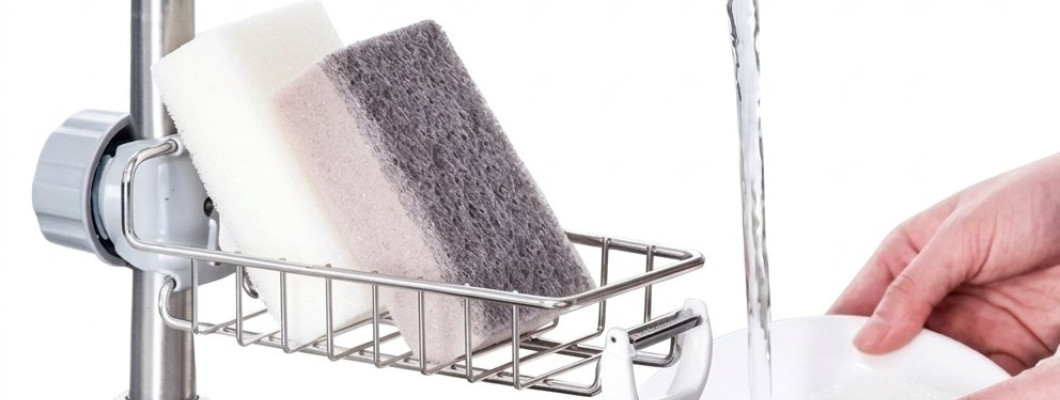
The K&M Shopping sink faucet organizer is an open-wire basket measuring 22.5 × 17.5 × 10 cm. It attaches around a compatible faucet neck with a tightening collar, without drilling or adhesive.
The collar diameter, adjustment range and load capacity are not specified. The exact metal is also unidentified. The listing describes moisture and rust resistance, which should not be interpreted as confirmation of stainless steel or a guarantee against all corrosion.
Product information:
https://k-m.store/shop/en/sink-faucet-organizer
Use these details to assess the storage footprint and attachment method. Clarify any missing specification that determines whether the organizer is appropriate for your faucet and intended contents.
Check Handle and Faucet Movement
Operate the faucet through the movements you normally use before choosing the final position.
Consider the space required by the control lever and your hand. If the faucet swivels, review its usual path. If it has a pull-out head, assess access for withdrawing and returning it.
The basket does not need to touch the water outlet to become inconvenient. It could occupy the space your fingers need or make one side of the sink harder to use.
Think about other household members too. A position that matches your usual approach may be awkward for someone else.
Preserve the sink’s basic functions first, then decide whether the proposed storage location adds convenience.
Plan Where the Drips Will Land
Look beneath the proposed basket position. Water leaving a wet tool may fall into the basin, onto the rim or into an awkward area behind the faucet.
An open basket does not direct those drops automatically. Its position matters.
Where the arrangement allows, choose a location that lets drips reach the sink without obstructing washing. If the only available position drains onto the worktop, consider whether that creates more wiping than the organizer saves.
Do not confuse drainage with complete drying or cleaning. The tools still need care according to their own instructions.
Evaluate the route of the water as part of the design decision, alongside fit and access.
Give Each Item an Easy Return Position
Start with a small selection of suitable daily tools. Place them so each can be removed and returned without rearranging everything else.
Try the action with your actual sponge and brush. A narrow handle or long head may make a tool awkward even when it technically fits inside the basket.
Avoid stacking several items simply to keep them out of sight. A visible, accessible arrangement is easier to assess and maintain.
If one tool repeatedly ends up outside the basket, investigate why. Its size, shape or frequency of use may call for a different location.
The storage plan should follow the tools you use, rather than requiring you to force them into a uniform display.
Treat Soap Containers as a Separate Decision
A container fitting within the basket does not establish that the organizer can support it appropriately.
Where load capacity is unspecified, do not estimate a limit from the product’s appearance. Large refill bottles may be better stored elsewhere.
Consider how you operate the soap container too. Pressing a pump while it remains in the basket is different from lifting a small item out and returning it.
Do not assume that storage suitability also confirms suitability for repeated downward pressure during dispensing.
It can be practical to keep the soap container in a separate compatible location while reserving the basket for the sponge and brush. Organization does not require every item to share one support.
Install the Organizer Empty First
Read the supplied instructions and understand the mounting parts before placing tools in the basket.
Position the empty organizer on the confirmed compatible section. Follow the specified assembly and tightening method rather than improvising extra layers around the faucet.
Review its placement, then check faucet operation and access again. Installation can reveal a clearance issue that was not obvious during initial planning.
Add only suitable contents and assess their arrangement. If the organizer moves or tilts, remove the items before investigating.
Do not automatically respond with greater tightening force. Reconsider compatibility, positioning and the intended contents, and seek guidance if the cause remains unclear.
Test an Ordinary Washing Session
Choose a typical task rather than evaluating the organizer solely while standing back and looking at it.
Reach for the sponge, operate the faucet and handle a familiar dish. Notice whether your movements remain straightforward.
Then consider a larger piece of cookware you wash regularly. Rehearse its movement carefully without deliberately striking the basket.
If access becomes restricted, revisit the location within the permitted mounting arrangement or consider another storage method.
The organizer should not make a sponge easier to reach while making the basin harder to use. Judge the complete task, including retrieving tools, washing, rinsing and returning the tools afterwards.
Build a Short End-of-Use Routine
After washing, care for the tools according to their instructions and return them to their designated places.
Check that the arrangement has not become crowded and that nothing unnecessarily covers the open base.
Wipe surrounding areas where water has collected. Installing storage does not mean the sink rim or worktop will remain dry without attention.
Link the reset to an activity that already happens, such as finishing the main washing session. Keep the sequence simple enough to repeat.
A brief routine makes it easier to notice when an item does not belong in the basket or when the chosen position is creating an unexpected inconvenience.
Make the Arrangement Clear in a Shared Kitchen
Agree on which items belong in the organizer and where occasional tools and spare supplies are stored.
A complicated system is unnecessary. The useful point is that everyone knows where to return the daily sponge and brush.
If someone consistently leaves a tool elsewhere, ask what makes the intended location inconvenient. The basket may be too crowded or the approach awkward.
Adjust the cause rather than assuming that an additional organizer is needed. Reducing the contents may be more effective than adding storage.
In a shared kitchen, success means the arrangement is understandable and usable by the people who actually wash at that sink.
Reassess Separately for a Bathroom Basin
A bathroom basin deserves its own compatibility and clearance assessment. The faucet may have a different shape, and the space between it and the wall may be smaller.
Define the basket’s role before installing it. If it is intended for basin-cleaning tools, keep that purpose clear rather than mixing in unrelated personal-care items.
Check access for ordinary handwashing and cleaning around the faucet. A mounting collar can fit while the overall arrangement still makes the basin awkward.
If the space is too limited, consider another storage location. The appropriate solution depends on the basin’s daily use, not just whether an accessory can physically be attached.
Keep Cleaning Access in the Plan
Choose a location you can reach for cleaning, and follow the product’s removal and care instructions.
Empty the organizer before cleaning rather than working only around its contents. Include the attachment area in your inspection.
Use methods appropriate to both the organizer and the faucet finish. Do not assume that one cleaning product is suitable for every nearby material.
After reinstalling, review the position before replacing the contents. The earlier arrangement may not have been restored exactly.
Stop using damaged components or a mounting arrangement that no longer functions appropriately. Adding more items or changing their distribution should not be used to hide a problem.
Review the Contents Weekly
During your regular kitchen tidy-up, remove the contents and assess each item.
Ask whether it was used, whether it belongs near the faucet and whether it can be retrieved easily. Return spare supplies to their proper storage location.
Look below and around the basket too. Repeated water collection in one place may indicate that the position or tool arrangement needs reconsideration.
You are not trying to preserve a showroom appearance. The useful measures are access, washing space, cleaning access and a clear return location.
A weekly review helps prevent a small organizer from gradually becoming a container for objects that have no other assigned place.
Common Mistakes to Avoid
Checking basket size but not the collar
Storage dimensions and mounting compatibility answer different questions.
Assessing only an empty sink
Include handle movement and the cookware you actually wash.
Assuming a large bottle is suitable because it fits
Physical space does not establish load capacity.
Covering the drainage area
Consider the effect of any added liner before changing an open design.
Treating the organizer as a cleaning device
It does not wash or disinfect the stored tools.
Tightening harder whenever something moves
Empty the basket and identify the cause first.
Keeping all spare supplies beside the faucet
Reserve immediate access for the items used in the current routine.
Before-Buying Checklist
I have identified the daily tools that need storage.
I have inspected the intended mounting section.
I have recorded its size and shape.
I have clarified the collar range if necessary.
I have compared the basket dimensions with available clearance.
The handle and faucet can still operate normally.
Large cookware can still be handled.
I know where drips are likely to land.
I have not assumed an unpublished load rating.
The mounting area remains accessible for cleaning.
I have considered another location if this arrangement does not fit.
Quick Answers
Most important first check
Confirm the mounting requirements against a specific section of your faucet.
Does a larger basket always help?
No. Extra capacity is useful only when it does not interfere with washing or encourage unnecessary accumulation.
Does drainage mean the area stays dry?
No. Consider where the water goes and maintain the surrounding surface.
When should you choose another organizer?
Choose differently when the collar, clearance or intended contents cannot be confirmed as suitable.
Frequently Asked Questions
Is this a bracket for repairing a loose faucet?
No. It is a storage organizer. Address any faucet movement or plumbing fault separately before adding accessories.
Will it fit every kitchen faucet?
That cannot be guaranteed. Assess the intended mounting section and obtain the collar measurements needed to confirm compatibility.
Do basket dimensions establish faucet compatibility?
No. They help you evaluate the storage footprint. The collar and mounting location require separate checks.
Does installation need drilling or adhesive?
This model uses a tightening collar around a compatible faucet neck. Follow its instructions rather than adding improvised mounting methods.
Is the basket definitely stainless steel?
The exact metal is not stated. Moisture and rust-resistance wording does not establish a specific material or grade.
Can I put a large soap bottle inside?
Do not assume suitability when load capacity is unpublished. Consider another appropriate location for large containers.
Does the organizer disinfect a sponge or prevent odours?
No such performance is established. Storage and drainage do not replace tool cleaning, care or replacement according to the relevant instructions.
What should I do if the basket tilts?
Remove the contents and reassess the mounting, compatibility and arrangement. Do not continue adding items or automatically apply more tightening force.
Can it be used at a bathroom basin?
Only after assessing that basin separately for compatible mounting, clearance and normal access. Define the intended contents clearly.
How can I tell whether the arrangement works?
Test a normal sequence: retrieve a tool, operate the faucet, wash an item, return the tool and wipe the area. Ease throughout that sequence matters more than appearance alone.
Step-by-Step: Start with One Sink
Step 1: Clear the existing collection
Separate daily tools from occasional items and spare supplies.
Step 2: Define the storage need
Choose the specific objects that need a place beside the faucet.
Step 3: Check mounting compatibility
Record the intended section and clarify any missing collar measurements.
Step 4: Assess the surrounding space
Include faucet movement, cookware clearance and drip direction.
Step 5: Install empty
Follow the supplied instructions and review the position.
Step 6: Add suitable contents
Keep the arrangement simple and accessible.
Step 7: Try a normal washing task
Notice what becomes easier and what needs adjustment.
Step 8: Maintain and review
Clean according to guidance and revisit the contents periodically.
Conclusion
A useful faucet-mounted organizer fits the faucet, the available space and the tools you use each day. Those checks matter more than filling a basket or clearing every object from the worktop.
Confirm the mounting arrangement, plan where water will go and test an ordinary washing session before deciding the setup is complete.
For kitchen and household organization products, browse K&M Shopping:
Quick Summary
Check the collar separately from the basket footprint.
Preserve faucet operation and cookware clearance.
Keep appropriate daily tools within reach.
Do not infer metal type or load capacity.
Include drainage direction and cleaning access.
Choose another storage method when the arrangement obstructs the sink.
Read Also
Over-Cabinet Bag and Towel Holder: Kitchen Organization Guide
https://k-m.store/shop/en/over-cabinet-bag-towel-holder-kitchen-guide
This related guide considers another storage location. It can help you distribute kitchen tools according to where they are used rather than gathering every item around the sink.
Leave a Comment