
Choosing a Back and Shoulder Support: A Guide to Size, Adjustment and Limits
Choosing a Back and Shoulder Support: A Guide to Size, Adjustment and Limits
Searching for a back support can bring up several different products: waist belts, shoulder straps, posture reminders, prescribed braces and weightlifting belts. Similar names and photographs can make them look interchangeable, even though their intended uses are not the same.
Before choosing one, decide what you are asking it to do. Wanting a reminder to notice your shoulder position during desk work is different from seeking treatment for persistent pain. A product description cannot determine the cause of symptoms or establish which medical support, if any, someone needs.
This guide focuses on the practical questions behind choosing a general back, waist and shoulder support: sizing, adjustment, access to the fastenings, care and the limits of the product’s role. It also explains what K&M Shopping’s Medium support listing confirms and which details still need clarification before purchase.
Quick Answer
Choose a back and shoulder support by checking its intended purpose, product-specific measurements and adjustment instructions. Medium clothing size alone does not establish a suitable fit, and being able to close the belt is not enough. Wear should not cause pain, numbness, tingling or restricted breathing or movement. If you are shopping because of persistent pain, injury or a diagnosed condition, seek professional assessment rather than treating a general support as a medical solution.
Contents
Separate posture awareness from medical treatment.
Understand the design before comparing products.
Review the confirmed K&M specifications.
Check sizing and ask for missing measurements.
Prepare for wear and follow adjustment instructions.
Recognise discomfort and avoid invented wearing schedules.
Review the workstation and everyday routine.
Consider practical use scenarios.
Clean, inspect and store the support.
Use the checklist and frequently asked questions.
Start with the Reason You Are Shopping
Write down the specific problem you want to address. You might want to notice when you lean towards a screen, or you might be looking for a design that includes both waist and shoulder sections. Those are different questions from asking what will treat ongoing back pain.
If your search follows an injury, surgery or a diagnosis, begin with your treating professional. A general retail support should not automatically replace a prescribed brace because the straps look similar. The appropriate product and instructions depend on the situation, not on the shared word “support.”
A Posture Reminder Is Not a Treatment Promise
The K&M listing describes the shoulder straps as a physical reminder of upper-body position. That explains the intended role of the design. It does not establish permanent posture correction, treatment of spinal curvature or guaranteed pain relief.
NICE guidance on low back pain and sciatica in people aged 16 and over advises against offering belts or corsets to manage low back pain, with or without sciatica. A general support therefore should not be presented as an established treatment for that problem.
This is not a reason to stop using a brace prescribed for a particular condition without advice. Ask the professional overseeing your care about that device. Choosing a general posture-awareness product and following an individual medical plan are separate decisions.
Understand the Construction Before Comparing Names
A waist-only belt differs in construction from a support that also extends to the shoulders. With a combined design, closing the waist section does not settle the entire fit: the rear panel, shoulder loops and strap routes matter too.
Likewise, visible rear supports do not identify their exact material, rigidity or clinical function. Mesh panels do not guarantee that a wearer will remain sweat-free. Read the stated specifications rather than turning every design detail into an assumed benefit.
What the K&M Product Listing Confirms
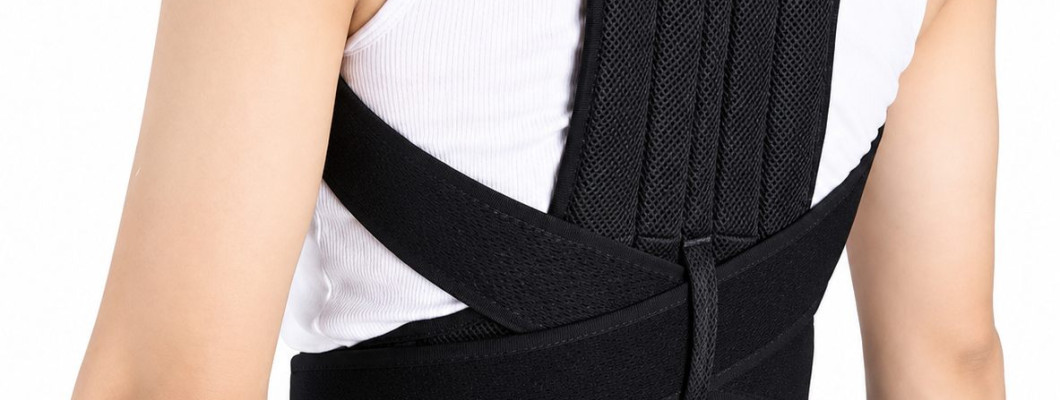
K&M Shopping lists a black back and waist support with adjustable crossed shoulder straps. Its construction includes a wide waist belt, an extended rear panel, two vertical support stays, hook-and-loop closures and mesh sections.
The verified English product page is:
The available size is Medium (M) only, and the stated package content is one support in that size. The listing presents it for general support and posture awareness during selected light daily activities, rather than treatment of a medical condition.
The exact fabric composition and material of the rear stays are not specified. A numerical body-measurement range is also not provided. Do not infer cotton, neoprene, metal or another precise material from appearance, and do not substitute a different brand’s size chart for this missing information.
Why Your Usual Medium Shirt Is Not Enough
Clothing size is a starting reference, not confirmation that a support will fit. Products can differ in their measurement points, closure overlap, rear-panel length and shoulder-strap arrangement.
Ask for the body-measurement range the product is designed to accommodate and the instructions for taking those measurements. The location of the measurement matters; guessing which part of the waist or torso to measure can create a misleading comparison.
If a product-specific chart is available, use that chart. Do not copy one from a similar-looking listing and assume it applies. If measurements remain unavailable, recognise the uncertainty rather than treating adjustability as proof of universal fit.
An adjustable closure offers some ability to change tension or fastening position. It does not establish that every wearer can achieve appropriate panel placement or shoulder fit. Sometimes the sensible outcome is to wait for clearer information before ordering.
Useful Questions to Ask Before Purchase
Ask what measurements define Medium, where they should be taken and whether the full wearing instructions can be viewed. If reaching around your body or handling fastenings is difficult, ask how the straps are accessed and adjusted.
Prepare Before Trying the Support
Read the instructions supplied with the product and inspect the straps, closures and rear panel for damage or twisting. The listing recommends a thin cotton shirt underneath to reduce direct friction. That does not guarantee freedom from irritation or make excessive tension acceptable.
Choose a situation in which you can notice how the support feels and remove it easily. Do not turn a first trial into a heavy-lifting session or strenuous exercise test. The product is not listed as a weightlifting belt or professional protective equipment.
Seek medical advice before use when you have persistent pain, an injury, a diagnosed spinal condition or relevant previous surgery. The product also flags circulation problems or reduced sensation as reasons to consult a professional. Do not wear it over wounds, inflamed skin or a rash.
Putting It On According to the Listing
The published instructions describe placing your arms through the shoulder loops, similar to putting on a backpack. Centre the rear panel over your back and position the waist section around the lower back and abdomen, following the actual instructions supplied.
Close the waist section securely without excessive abdominal pressure or restricted breathing. Adjust the shoulder straps evenly. They should not be twisted or cause strong rubbing around the shoulders and underarms.
Do not pull your shoulders backwards as hard as possible in pursuit of an appearance. The described purpose is a gentle reminder, not painful restraint. If you cannot achieve comfortable wear, more tension should not be treated as the answer to a possible sizing problem.
Check ordinary breathing and movement without turning the trial into an exercise challenge. These observations do not certify medical suitability, but they can reveal obvious discomfort. Remove the support if pain, numbness, tingling or breathing difficulty occurs.
What to Notice During Use
Pay attention to rubbing, twisted straps, shifting of the waist section and difficulty reaching the closure. How the support looks in a mirror is only one observation; it does not tell you how it feels during the intended activity.
If you repeatedly need to tighten the straps to keep the product positioned, stop and review the instructions and fit. Do not assume every slipping or positioning issue can be solved by reducing the circumference further.
Remove the product when symptoms occur rather than trying to tolerate them. Seek medical assessment if symptoms persist or recur. A comfortable initial trial also does not establish that the support is suitable for every activity or for longer wear.
Avoid Inventing a Wearing Schedule
The product page does not provide a universal daily number of hours. Another person’s schedule or an online review cannot establish the right duration for you, especially if your reason for wearing the support is health-related.
The listing suggests beginning with a short period and monitoring comfort. That should not be interpreted as a programme of automatically increasing wear each day. Ask a qualified professional about suitability and duration when symptoms or a medical condition are involved.
Longer use should not be assumed to produce greater benefits. Do not sleep in the support without specific professional guidance. Time worn is not a meaningful target on its own; suitability, comfort and the intended role of the product matter more.
Review the Workstation Alongside the Purchase
Look at the practical reasons you move towards the screen. Is the text difficult to read? Is the phone positioned where you repeatedly look down at it? Do you have to reach forward for the keyboard or mouse?
Reconsider where frequently used items sit and whether the display and reading materials are accessible. There is no need to impose one fixed measurement on every person, chair and desk. The arrangement should make the task manageable for the actual user.
Keep opportunities to change position and activity within your routine, as appropriate to your circumstances. Do not use the support as a reason to remain in one position for longer. If a professional has recommended exercises or a treatment plan, the product should not replace that advice.
Three Situations That Lead to Different Decisions
A Desk Worker Seeking a Reminder
Start by noticing when and why you move towards the screen, then review the placement of equipment. If considering a general posture reminder, check measurements and comfortable use without expecting permanent correction from wearing it.
Someone Shopping Because of Persistent Pain
The priority is understanding the symptoms and obtaining appropriate guidance. Comparing prices and sizes should not replace that assessment. A friend’s experience or a favourable product review cannot identify the right approach for your condition.
Someone Looking for a Heavy-Lifting Belt
This product is not listed for that role. Rear stays or a feeling of tension do not make it interchangeable with equipment selected for a particular activity. Do not rely on it as protection against lifting injuries.
Make Everyday Observations Specific
If the product is suitable for you, focus on practical questions. Did the straps remain untwisted? Could you operate the fastening easily? Did a particular area rub? Those observations are more useful than guessing that your body shape changed after a brief trial.
Before another use, check that the support is clean and dry and that the skin in the covered area is suitable for wear. If you change the clothing underneath or the intended activity, review the adjustment rather than automatically relying on the previous setting.
Cleaning the Support
The product page specifies hand-washing in cold water with mild detergent. Fasten the hook-and-loop closures before washing so they do not catch on the fabric. Also follow any additional instructions provided on the item’s label or in its packaging.
Do not use bleach, machine washing or a mechanical spin cycle. Avoid twisting or wringing forcefully. The presence of rear stays is a reason to handle the construction carefully rather than assuming flexible fabric can tolerate any cleaning method.
Allow the support to air-dry naturally in the shade, away from direct heat. Make sure it is completely dry before wearing or storing it. Store it without compressing the stays or allowing the closures to catch on other clothing.
A Weekly Product and Routine Review
Inspect the straps, fastenings, stitching and rear sections for visible damage or changes. If a closure no longer functions properly, do not compensate with extra tension or an improvised modification.
Review why you are using the product too. Has a general reminder become a way of ignoring pain or extending uninterrupted sitting? If the purpose has shifted towards managing symptoms, seek appropriate advice rather than quietly expanding the product’s role.
Common Mistakes to Avoid
Assuming Medium Fits Everyone
The letter M does not establish compatibility with every body. Ask for product-specific measurements and do not borrow a chart from another brand.
Equating Stronger Tension with Better Results
More pressure does not prove better support or faster correction. Do not continue through pain or tingling, or tighten the product to conceal a fit problem.
Replacing a Prescribed Device Without Advice
A general support is not automatically equivalent to a medical brace. Similar names or photographs do not establish the same purpose or suitability.
Inferring Materials and Sports Uses
The precise stay material is not stated, and the product is not presented as a weightlifting belt. Keep the choice tied to confirmed details rather than appearance.
Before-Use Checklist
The purpose is clear and does not depend on a treatment promise.
Medium is the listed size, and suitability has been checked.
Missing measurement information has been requested where needed.
The closures and strap adjustments are understood.
Closing the belt is not being treated as the only fit test.
Product instructions and warnings have been reviewed.
There is no painful pressure or restricted breathing or movement.
The support will be removed if pain, numbness or tingling develops.
It is not replacing a prescribed brace or treatment plan.
It is not being used as a heavy-lifting belt.
Washing and drying requirements are understood.
The work routine does not rely on the support alone.
Quick Answers
Which size is listed? Medium (M) only.
How is it adjusted? Through the waist closure and adjustable shoulder straps.
Are the exact materials known? The fabric composition and stay material are not fully specified.
Is there a universal wearing duration? No fixed schedule is established for everyone.
What is the stated role? General support and posture awareness, not medical treatment.
When should it be removed? If pain, numbness, tingling, irritation or breathing restriction develops.
Frequently Asked Questions
1. How does this design differ from a waist-only belt?
It combines a waist section with a rear panel, shoulder straps and two vertical stays. That is a construction difference, not proof of greater medical effectiveness.
2. Which size does K&M list?
The available size is Medium (M) only. Check the current product options when ordering rather than assuming other sizes are offered.
3. Will it fit if I wear Medium shirts?
Not necessarily. Clothing size alone does not establish support fit. Ask for the product’s intended body-measurement range and measuring instructions.
4. Does it treat back pain or spinal curvature?
It should not be used as a treatment for those conditions. Seek professional advice if symptoms or a diagnosed problem are the reason for considering it.
5. How can I tell if the tension is excessive?
Pain, numbness, tingling or restricted breathing or movement are reasons to remove it. Do not treat those effects as a normal adjustment stage to endure.
6. How many hours can I wear it each day?
There is no universal schedule in the listing. Follow product instructions and qualified advice where relevant, without automatically increasing duration.
7. Can it be worn against bare skin?
The listing recommends a thin cotton shirt underneath to reduce friction. Continue monitoring comfort and skin condition; the extra layer does not guarantee suitability.
8. Is it suitable for sleeping or weightlifting?
It is not a weightlifting belt or professional protective equipment. Do not use it during sleep or vigorous exercise without specific qualified guidance.
9. How should it be washed?
Close the fastenings and hand-wash in cold water with mild detergent. Avoid bleach, machine washing and forceful wringing, then air-dry in the shade.
10. Does it replace workstation changes or movement?
No. It should not replace reviewing your workspace, changing activity or following exercises and care recommended by a qualified professional.
A Step-by-Step Starting Plan
Identify whether the goal is general awareness or a response to symptoms.
Seek professional assessment when symptoms or a condition require it.
Review the design and request missing sizing information.
Read the supplied wearing and care instructions.
Adjust without painful tension or restriction.
Monitor comfort and remove the support when warning signs occur.
Review the workspace and avoid relying on the product alone.
Clean, dry and inspect the item as instructed.
Conclusion
Choosing a back and shoulder support requires a clear purpose, verified sizing and realistic limits. Adjustable straps and a larger rear panel do not establish treatment benefits or permanent correction, and they do not replace missing measurements.
Base the decision on the product’s actual information and seek qualified guidance when pain or a diagnosed condition is involved. That keeps a general retail purchase separate from a medical decision requiring individual assessment.
Quick Summary
The listed K&M support is black, Medium-sized and combines waist and shoulder sections with two rear stays. Check measurements, avoid excessive tension and do not invent a universal wearing schedule. Follow the hand-washing instructions and stop use when symptoms occur.
Read Also
If your phone is part of your work or study routine, this desk phone stand guide discusses device positioning and practical fit. Treat the accessory as an organisational tool rather than a treatment:
https://k-m.store/en/adjustable-desk-phone-stand-height-video-calls-guide
For the store’s published product information, visit K&M Shopping:
Health reference: NICE guideline NG59, recommendations on orthotics for low back pain and sciatica:
https://www.nice.org.uk/guidance/ng59/chapter/recommendations
Leave a Comment